How to become a Facebook sensation in 10 easy steps

Another in my acclaimed series of how-to articles.

  1. Publish a blog alleging something preposterous, like “Walmart Paper Towels Used in Obamacare Plot to Cover up Monsanto Assassination of Hugo Chávez,”
  2. Arrange for a friend with Photoshop to have Batman saying it while slapping Robin.
  3. Post the result on Facebook, with a caption, like, “Wow!  Just…wow!” or something similar.
  4. When someone points out that it is, in fact, utterly ridiculous, accuse that person of censorship.
  5. Share your own post, asking why the mainstream media have been ignoring this story.
  6. When lulzsec offers to crash the FBI website in protest, share that, too.
  7. When Fox News calls, tell them you got the story from Huffington Post.
  8. When Huffington Post calls, tell them you got the story from Fox News.
  9. When interest wanes, pretend Facebook tried to shut you down.
  10. Start a petition against Facebook.

The 10 realizations

  1. Holy shit, I’m going to die!
  2. I might as well eat, drink and be merry.
  3. This might make me die sooner, so, I should eat healthy and exercise.
  4. I could get hit by a truck and die anyway.
  5. If I eat healthy, exercise, and drink a lot of expensive hooch, I’ll cover all the bases.
  6. Expensive hooch is no better for me than cheap hooch, and costs more.
  7. If I eat a lot, build huge muscles, and drink cheap hooch, people will think I’m an existentialist.
  8. If I learn a martial art, people will think I’m a dangerous existentialist who doesn’t fear anything.
  9. If people think that, they will want to test me.
  10. Holy shit, I’m going to die!

Fool me, fool you

People say they don’t suffer fools gladly.  Nonsense.  I have seen fools afforded undivided attention, encouraged, even applauded, by people who knew perfectly well what foolishness was being perpetrated.  It’s contradiction they don’t suffer gladly.

I understand completely.  Nobody likes to be corrected publicly; it makes us feel like the fools we’re not supposed to … suffer. (I think we like that word because it carries implications of discomfort with idiocy to the point of physical pain.)  In any case, if we, the contradictees, suspect the contradictor is right, that just makes things all the worse.

But it’s the usual response to this most understandable of embarrassments that I object to.  Lately, and most certainly online, that tends to be character assassination.  It goes well beyond mere ad hominem and into the realm of vendetta.  I suppose this is not surprising, given the convergence of extreme-ness as the ultimate cultural value, and the mask, if not the anonymity, afforded by electronic communications.

What do I do in such circumstances, then?

First of all, let me assure you of my qualifications in this arena.  I have been contradicted many times, both publicly and privately.  The clear majority of those times, I was wrong.  So I approach this with considerable experience; it is not just a theoretical exercise for me.

When someone points out a fatal flaw in a disquisition I have been presenting with the air of inevitability, I respond by first holding my breath and staring at that person.  Then I roll my eyes, subtly change the subject, and point out that the objection lacks any validity whatsoever against the new subject.  If the person then has the temerity to point out that I have changed the subject, I throw up my hands, mutter, and leave the room.  After a suitable period, (no less than an hour is generally recommended) I can bring up the topic again, with a thoughtful air, as if I had arrived at the correct conclusion, not all by myself, for that would be dishonest, but in friendly collaboration.

This is the method recommended by most experts today, although it used to be second nature to the well-educated.  Here’s an example:

A highly distinguished professor was presenting a lecture on the identity of the architect responsible for a famous sanctuary in the ancient Hellenistic world.  This had been a topic of controversy for generations, and the professor had devoted much of his later career to resolving the issue, using methods from a variety of disciplines.  He attacked it from all angles, considered every point; it was an interdisciplinary tour de force.  He carefully laid out the elements of the puzzle, piece by piece, leading up to the culminating statement of his presentation, “I can now reveal to you, without a trace of a doubt, that the man responsible for this sanctuary was none other than  ____!”

A slow murmur of admiration, a gasp almost, began at one corner of the room and worked its way toward the other.  A stirring, a hand clap, then another, the beginnings of applause as the implications sank in.

Suddenly, a perplexed looking student rose, and said, “But, wasn’t ____ in Alexandria at the time?”

Dead silence.  The gasps and murmurs, now mixed with confusion, retreated along the same paths by which they had come.  The distinguished professor said nothing, but simply looked at the student, expressionless, until the audience began to drift off.

Now that‘s class.

Peasants

No one understands the peasant.  Not the lords in their manor houses, not the bloody saviors of the masses, not all the bishops in hell.  Whether they think we need saving, scourging, stamping out, breeding, baptizing, arming, disarming, manipulating, controlling, or just crushing underfoot, none of them understands one simple truth: after they’ve burned and pillaged each others’ castles and cathedrals to the walls of Armageddon, we’ll still be here, not much the worse for the wear.  It’s what Jesus meant about the meek inheriting the Earth.  He wasn’t pontificating, just stating a simple fact.

Peasants belong to the Earth.  She is our mother, not in some New Age, crystal gawking way, but as an ordinary truth.  We’re more feral than not.  We sprang from the soil like autochthons; in the great divine arc of history, our job was to provide pillage.

We tend to be naive, and easily duped.  It’s not something that can be educated out of us.  It’s a genetic propensity to take others at face value, and we’re stuck with it.  You might argue that this is a fatal flaw, yet here we are, aren’t we, while all the bloody Ulyanovs, Romanovs, and Cromwells have long since mouldered away clutching their cleverness to their poisonous hearts.  We hate and fear, but never despise.  We love too easily.  It’s our greatest weakness.  It kills us every time.  It’s what saves us every time.

Religion tends to fall lightly on our shoulders; we’re not built for worship when  reverence will do.  We have churches, but woodlands and moors are more sacred to us than pews.  On those rare occasions when religion settles into a peasant’s heart, it is an ugly thing.  Rasputin, sure, but Stalin and Mao had the disease just as surely, albeit behind a mask of social theory.  Peasants tend to overdo power in general.  It’s just like us, isn’t it?  Rubes, at heart, in loud suits.

My homeland, Latvia, is as pure a peasantry as you’ll find anywhere.  The culture, the very language, exists only because the lords and saviors who plagued us over the centuries didn’t think it worth extinguishing.  Typically, when Latvia gets praise, as it recently did from the IMF for being a model of the kind of austerity Europe needs to pull out of the recession, it’s for taking its flogging well, without causing trouble.  All the more disheartening, then, to learn that the flogging was not only unnecessary, but only made things worse after all: the theory behind all the demands for economic austerity has just been shown to be based on flawed data.

Suckered again.

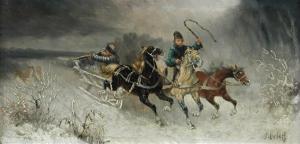
My great, great grandfather’s troika

Family stories beyond about two generations ought to be taken with a grain of salt.  But they ought to be taken, all the same, in the same way that myths must be taken.  There is a kind of truth in them, even with the embellishments required to fill in gaps.  This one concerns a great, great grandfather, a mild winter, and a wager.  A good combination, I should think.

It was, in fact, the mildest of winters in a part of the world where children’s tales involve ice maidens and ravening wolves, along with the occasional stark reminder that they’re not entirely fictional.  Snow comes early and often, and once the rivers and lakes freeze over they generally stay that way until the spring thaw.  Even today, in the deepest countryside, horse-drawn sleighs are not rare in winter time.  This particular winter the snows came late, and the air smelt of autumn into late November.  By the first couple of weeks of December, the waters had just begun to freeze, and a decent amount of snow had finally arrived, enough to change wagon wheels for runners in a land where roads were usually just a fond memory by this time.

My great, great grandfather, call him Jekab, lived out his life there, fortified against the deathly winters with buckets of vodka.  And the summers, come to that.  This was not a poor man, as these things go; he had a troika, a three-horse wagon, and any man who could use three horses just to get around was pretty well off.  Jekab even had his own little piece of land, a rarity in that time and place.  To be sure, he worked it himself, with help from the family.  You wouldn’t call him lord of the manor, but he was lord of the local tavern, for sure.  The long winters left farmers rather little to do beyond experimenting with various percentages of blood alcohol.  Jekab’s usual comrade in these endeavors was a sometime roustabout and usual layabout whom we shall call Gint.

This particular winter’s afternoon found Jekab and Gint sitting at their favorite seat at the tavern, overlooking the river.  Snow poured from the sky relentlessly.  The talk turned to a particularly alluring miller’s daughter, God bless and protect her, who happened to live at the mill just across the river.  As it happened, the ferry that crossed from just that point had finally shut down due to icing, and the nearest bridge was at least five kilometers away.  Snow already covered the icy river to a depth above the boot.  Still, Jekab expressed a desire to pay a visit to the lovely young lady, never mind his wife and children at home.  Gint, with his usual gift for claiming the obvious, scoffed.

“The snow’s up to your ass out there!”

“You’re the ass,” Jekab responded,”Knees, tops.”

“But you’ll fall on your ass after two steps, then where will the snow be?”  Both men roared with laughter at the thought of it, tears streaming down their faces.

Silence returned gradually.  Jekab looked straight into Gint’s rather bleary eyes.  “I’ll take the troika, you stupid shit.”

“You’d drive all the way to the bridge for her on a day like this?”  His eyes widened, truly impressed with such dedication.  But Jekab just waved away his words, as if they were no more than summer flies.

“Don’t be daft,”  he said.  “I’ll cross the river here.”

There ensued a lively debate about the thickness of the ice on the river, with Jekab insisting that if it could support all that snow, it could support a troika, and Gint pointing out that the weight of the troika would be added to the weight of the snow.  In the end, a wager was made.

The two men, along with a handful of the curious, stood in front of the tavern.  Jekab harnessed his horses to the troika and climbed aboard, turned it toward the river, and gave the reins a firm and resounding slap.  Off they went.

It must have been quite a sight.  Steam rising from the horses’ nostrils, the troika’s runners cutting through the mighty snow bank onto the river, Jekab swathed in fur, urging his horses into the blinding storm at the top of his lungs.  Then – silence.  They all disappeared.  All of them: horses, troika and great, great grandfather.  None of them was seen again until the spring sun melted the ice against the bridge down river.

Gint had won his bet, but lost his friend.  Life is like that.

T. Orloff.  19th c. Russian
T. Orloff. 19th c. Russian