Let’s get one thing straight at the outset: Saving your own ass is a perfectly honorable reason to avoid military service, if you don’t see a compelling reason to go to war in the first place.
And another thing: those were crazy times, the 60s.
The beats, those semi-feral gnosticati whom we came to later venerate, were creatures of the WW II aftermath, in exactly the same way as the Lost Generation was of WW I. An incomprehensibly brutal war had beaten the bejeezus out of the population at large, and those few sensitive and creative souls who could banded together in resistance to the Great Blanding that followed. They were artists, primarily, painters, poets, musicians, above all uncynical and undisillusioned, still willing to bite on the bare hook, still enthralled by beauty and the ideal. Do I surprise you? That cynical, hip beatnik pose that’s so familiar was a disguise at most, at worst a caricature painted by a society that wanted nothing remotely experimental to happen for the foreseeable future. The war and the depression it followed had been adventure enough, thanks.
But, for better or worse, the beats became famous, especially for naturally rebellious young folk, always feeling stifled, but particularly in that post-war treacle of the 1950s. For them, Kerouac, Ginsburg, Ferlinghetti, and the rest represented not only freedom from accountability, but an expression of creativity completely unfettered by the constraints of the responsible, normal, world. Never mind that Kerouac actually lived with (not to say on) his mother in Lowell between cross-country adventures, or that Ferlinghetti had served honorably in the Navy during the war. Come to that, never mind that most of the people who so earnestly emulated them were safely enrolled in college. It was a ramblin’ kinda thing by the early 1960s, a confusion of Woody Guthrie and William Burroughs, sort of a gay, jazzed up Alan Lomax thing, a place where Coltrane and Leadbelly were equally likely to be heard on the hi-fi in any given off-campus apartment. And, thanks largely to sheer romance, it was all vaguely leftist. Posters of Rosa Luxembourg, or someone equally suitably obscure, were everywhere. People carried anarchist paperbacks in their hip pockets. It never occurred to most to read the damn things. Best of all, it was cozily small, an invitation-only subterranean elite.
I say this stuff as a member of that wannabe tribe, or, more accurately, as a wannabe member of it; my own background was far too odd for easy acceptance in what amounted to a splinter group of the middle class. I was born a refugee, a natural intellectual, an ex-Catholic who grew up in a not-so-pretty working class neighborhood, in which the inhabitants would never have dreamed of calling themselves working class, or any other class for that matter. In my neighborhood, graduation from reform school was as typical as graduation from high school, and of roughly equal status. Almost nobody outside my immediate family went on to college. Such was my enculturation; I didn’t have the savoir faire for acceptance as a middle class rebel. Worse yet, as an exile from Latvia, I had no great affection for Marxist pipe dreams. But enough disclosure.
In the midst of this happily angst-ridden fairyland, the war in Vietnam came gnawing like a small but determined troupe of mice in the pantry. Begun by Eisenhower as a way to shore up Indochina after the expulsion of the French, it might have remained an obscure haven for covert operations, but for a series of circumstances, too complex to go into here, that led Lyndon Johnson to try to win it and get out quickly. That meant escalation, and that meant that the draft, which during much of the late 1950s and early 1960s had been little more than a minor nuisance, became a jarring reality to the pleasant little community of rebellious savants, many of whom were in and out of college as if it were a game of musical chairs. This was a real problem when it came to student draft deferments. In those early days, if you lost your 2S status, you were next. What to do?
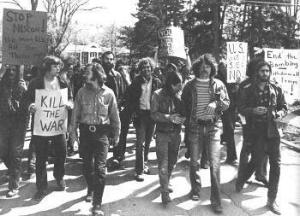
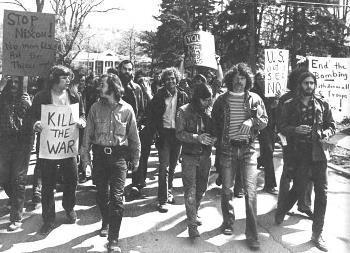
Why, protest, of course. At first, it was uncomfortably small groups carrying signs, in emulation of the Ban-the-Bomb rallies a decade earlier. Intellectuals, who had studied the background to the war and had an understanding of the stakes, and of its place in leftist dogma. Later, as more and more young men in college realized they could very well end up in the Army if nothing changed, the ranks were far less well informed, but considerably more sanguine. I don’t impugn the integrity of each and every war protester of the era; there were certainly many who were sincere in their beliefs. But many more simply wanted to avoid a dangerous detour in their well ordered lives, and still others saw a way to exploit a growing movement for their own ends. Suffice it to say that the implications of the “Girls-say-yes-to-Boys-who-say-no” campaigns of the late 1960s were not lost on the many young men of the day.
Of course, people could have simply admitted that they saw no good reason for the war, and thus wanted to save their own asses. After all, saving their asses was what the young men who did go to war were doing every day; nothing dishonorable about it. Even those few who didn’t end up in Vietnam just by default of the system, and who really went on an idealistic mission to stop communism, in the end only fought to save their own asses, and those of their comrades. Honesty, as usual, though the best policy, was the least popular.
As a result of all this duplicity, it became a Matter of Principle, which is to say that people chose up sides and bitterly denounced those who refused to join them. It is a testament to this fundamental lack of good faith that to this day there remains a considerable amount of rancor in the remnants of the debate.
And me? I got drafted, and ended up joining the Air Force, serving in Okinawa and Germany, ironically skirting Vietnam altogether. I didn’t join because I believed in the war, or because I was afraid of the criminal consequences of dodging the draft. I joined so as not to break my father’s heart.
That’s about all the honor I had in me; it still is.
_____________________________________________________
Photo credit: http://www.alfred.edu/pressreleases/viewrelease.cfm?ID=7252


 Omniop
