How to build a fire

The woods around Frankfurt am Main, Germany, in the late 60s were scrupulously maintained by a cadre of forstmeisters.  Deadfall was cleared promptly, and cords of firewood kept at intervals along the well-groomed paths.  This was to be used elsewhere; open fires in these woods were strictly prohibited.  Germany, like all of Europe, was well trodden through centuries of settlement and resettlement, and Mother Nature was more a well kept mistress than a matriarch.

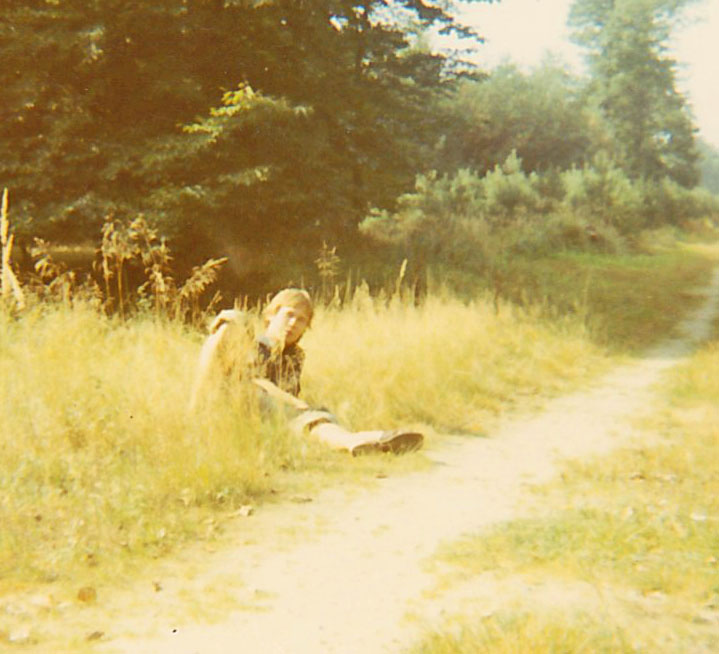
But this was, after all, the late 60s, and certain paths through certain quarters were undeclared free zones, and the minions of the psychedelic diaspora ran unfettered there.  In one such area, we maintained a kind of salon-in-the-wildwood, with a commandeered military shelter overlooking a campfire that was more or less permanently smoldering.  That fire saw faces and feet, new and familiar, come and go through many nights.  Tall tales, laughter, music, and in one case, an improvised artistic stick-throwing contest, filled those days and nights like the billowing cannabis smoke pouring from the tent.  It was, as I believe I’ve mentioned, the late 60s.

On one particular sodden day, after a solid week of rain, a friend, call him Chuck, and I arrived with the idea of cheering things up with a nice, cozy fire.  After a half hour of rummaging through the surrounding woods, we managed to collect a halfway decent pile of not-so-wet wood.  For kindling, there was always sufficient litter in the tent, partly collected for that purpose, partly the natural detritus of exuberantly youthful living.

So we began.  First, a crumpled piece of paper, with informally piled twigs atop, failed to catch.  Then Chuck suggested a teepee.

“What?”  I said, “You mean the tent?”   Chuck snorted and rolled his eyes.

“No, it’s a Boy Scout thing.  You stack small firewood in a kind of pyramid, then light it.”

“You were in the Boy Scouts?”

The teepee, too, smoldered hopelessly, as another friend, Herbie, arrived, surveyed the situation, and declared the obvious solution.

“You need a log cabin.”  Great, I thought, we’re going to run through the entire history of architecture here.

Nevertheless, what we were doing wasn’t working, so we carefully laid small sticks, of a size precisely to Herbie’s specifications, and stuffed paper from the dwindling supply into the ground floor.  The lighting ceremony was accompanied by the lighting of a large joint Chuck had been preparing.  All went marvelously well.

Except for the part involving the campfire.  It produced lots of smoke, but not much else.  Herbie declared all was going according to plan, that the wood just needed to dry out a bit.  Chuck pointed out the fire had been planned for that day, and not the next.  Chuck and I laughed uproariously.  Herbie grunted and stuffed the last remaining kindling into the structure.  We watched as the fire blazed up, consumed the dry paper like it was … dry paper, then died back to a dull occasional flicker.

Jens arrived.  Jens was from Antwerp, and as far as any of us could figure, had been on the road since shortly after birth.

“What’s happening?” he said.  From anyone else, this was a standard hippie greeting, the equivalent of a grunt of acknowledgment.  From Jens, it was a reasonable question.

“Trying to build a fire,” I offered, “but it’s just too wet.”  Gloom.

Jens looked at the pathetic little pile of semi-charred sticks, and, without a word, turned and walked away.  Just not willing to sit in the damp woods without a fire, I thought.

We continued our discussion of what to do next, whether the attempt was even worth continuing, when he returned.  He was dragging a sodden-looking, moss-covered log, about a foot in diameter and roughly five feet long, which he promptly dropped squarely on top of the remains of our fire building exercise.  A few halfhearted sparks flew out in protest.  A collective groan arose to compete with them.

“Jesus, Jens, thanks a hell of a lot!”  Herbie said.  He had still not used up the last of his theories in defense of the log cabin method.  Jens shrugged and sat down to join us.

We moped in silence for a good ten minutes, until the first flames began licking up the sides of the log.  In a few more minutes, the fire was roaring away; I was dumbfounded.  I looked at Jens with incredulity.

“What?”  he said.
IMG

“Jens,” not his real name

Le Juif Errant

For the end of a week in remembrance of the Holocaust, I am offering up this post of mine from a couple of years ago.


the-wandering-jew-1925

Le Juif Errant, Chagall, 1925

When I was a boy, I developed an aversion to the art of Marc Chagall.  Why?  Because some of his work was used to illustrate a catechism we were tortured with in St. Philip Neri School.  I had no way of knowing at the time that St. Philip himself, a notorious iconoclast, would probably have flung the damned book out the window if we found it distracting.  After all, when one of his monks came rushing to him all aglow with the news that the Virgin Mary had visited with him while he prayed, he advised him to spit in her face the next time she disturbed his meditation.  Had I known, I might still be among the faithful, but there it is.

But I digress, as usual.  It’s what I do, isn’t it?  At any rate, as time went by, and the pain of extracting the religion from the boy, or vice versa (I’ll never know which), matured into a dull tingling sensation, I came to appreciate artistic trinkets like the Cathedral of Notre Dame and the Pietá without revisiting the centuries of pilloried self-worth it took to create them.  I came also to love Chagall, whose work I had so unreasonably imprisoned in the ghetto of my anti-religiousness.

I particularly came to love his 1925 painting Le Juif Errant, The Wandering Jew.  I saw myself in that character, his home bundled on his back, passing window lit houses with their cozy fires, on his way to his appointment with the Second Coming.  If you’re not familiar with the legend, it involves a Jew who berated Jesus on the way to the crucifixion for stopping to rest.  As punishment, he was condemned to wander homeless, and deathless, until the Jesus returned triumphantly.  Considering that early Christians thought that event was just around the corner, it must have seemed to them a curiously lenient punishment at the time!

Actually, the legend only came into full flower in the European Middle Ages, long after the alleged fact, so I suppose that’s irrelevant.  It dovetailed nicely with the social realities of Judaism in that time and place, Jews often being in commerce and other trades involving traveling, and culturally separate from the largely agrarian Christians.  Of course, these elements played a crucial role in antisemitism as well.  In a time when both the Catholic Church and Islam forbade money lending, and when capitalism was just being born, Jews were the only group religiously allowed to do the necessary midwifery.  Awkward, to say the least.

Anyway, it was this essential otherness that appealed to me.  I was born in a Displaced Persons (refugee) camp following WW II.  The land that would otherwise have been my homeland, Latvia, had been requisitioned in the name of the people by Stalin and his cronies, without much consultation with said people.  I had nowhere to call home.  My family eventually settled in the US, and now I’m as American as apple pie and, er,  sour cream, but I still harbor a feeling of not quite belonging, anywhere, really.  I’m not complaining.  The casual presumptuousness and giddy brutality with which social membership is often enforced more than offset the cozy warmth of it, in my view.  There’s a feeling of freedom, as well, in not holding yourself responsible for the original foundational sin of the prevailing system, whatever that may be.  The price, of course, is total responsibility for your own choices, but that’s a fair bargain.

Latvia, the sweet, imaginary homeland of my youthful dreams, never existed, of course.  In its brief experiment with independence between the World Wars, there was a tendency to authoritarianism, especially toward the end.  We’ll never know how that would have ended, thanks to Uncle Joe. Then there was the shameful massacre of the Jews at Salaspils and other places while the country was in the grip of  German Nazis.  Some, perhaps even many, Latvians, like the Vichy French, enthusiastically participated.

But things were not always thus.  A couple of years ago, I was wandering through what used to be the Jewish ghetto in Riga, now a sort of Russian quarter near the city market.  The ghetto was “cleaned out” toward the end of 1941, all the occupants trundled off to a nearby forest, and exterminated like so many cockroaches.  Turning a corner, I came upon a construction fence, and, sitting at a makeshift booth at the entrance, a young man with a bushy beard and a yarmulke.  It was the site of a new Latvian Holocaust Museum.  There were the expected photographs of Nazi atrocities, of course, but also the less expected evidence of mistreatment under the hands of the Soviets, who so often seem curiously off limits when discussing such things.  But what moved me the most were the stories and photographs of Latvia before the Nazis, before the Soviets, a country where Jews fleeing the progroms of czarist Russia could find a home.  Every major city in the country had a strong, proud Jewish heritage; Riga had one of the great yeshivas of Eastern Europe.  There was antisemitism, yes, but not as strong and not as institutionalized as elsewhere.  The nostalgic pictures of Jews during the inter-war independence years were especially moving, considering how all that came so cruelly to an end.

The Jewish population of Latvia was all but wiped out.  Even now, all these years later, it is still struggling to regain a footing.  As I see it, it’s a big chunk of my own cultural heritage, Jew or gentile, that’s been torn savagely off.  It’s genuinely heartbreaking.

Well, I’m not a Jew, so I guess I can’t be a Wandering Jew, my romantic imagery notwithstanding.  But we can travel together for a while and keep each other company.

Dude.

In the 21st Century, everybody’s hip.  When everybody’s hip, you get all the arrogance without the artistic and intellectual excuses for it.

The 10 habits of the ultra-rich

Follow these simple rules, and you, too will be fabulously wealthy one day!

  1. Inherit money.
  2. Steal money
  3. Extort money
  4. Win money.
  5. Pilfer money.
  6. Embezzle money.
  7. Appropriate money.
  8. Rob money.
  9. Filch money.
  10. Grab money.

The 10 realizations

  1. Holy shit, I’m going to die!
  2. I might as well eat, drink and be merry.
  3. This might make me die sooner, so, I should eat healthy and exercise.
  4. I could get hit by a truck and die anyway.
  5. If I eat healthy, exercise, and drink a lot of expensive hooch, I’ll cover all the bases.
  6. Expensive hooch is no better for me than cheap hooch, and costs more.
  7. If I eat a lot, build huge muscles, and drink cheap hooch, people will think I’m an existentialist.
  8. If I learn a martial art, people will think I’m a dangerous existentialist who doesn’t fear anything.
  9. If people think that, they will want to test me.
  10. Holy shit, I’m going to die!