
Participating in democracy is not just shouting your particular dogma more loudly. It’s having the courage to face that dogma, and test it, to research and confront your most ingrained ideas. This requires hard work, I’m afraid, and may cost you some fair weather friends. If this doesn’t appeal to you, I’m sorry. Maybe democracy is not what you want.
Born yesterday
I’m up in Sault Ste. Marie, MI, in a little gift shop near the great locks that pass ships between the high waters of Lake Superior and the lower Lake Huron, bypassing the St. Mary’s River rapids (sault in French). A thousand-foot Great Lakes freighter is passing by, on her way to the locks. A much smaller boat is ahead of her, looking for all the world like a leading dolphin, and someone asks, “Is that a pilot leading the freighter to the lock?”
“No, that’s your $10 million government boat,” answers the clerk, with a knowing smirk. We’re supposed to smirk back in that knowing way we have when we don’t actually know, but suppose the speaker does.
“Coast guard?”
“Homeland Security.” This with more of a smirk. We’re all in the know here; the government can’t pull the wool over our eyes!
“I’ve heard,” the clerk continues, “that they can read your credit card from a mile away.”
That does it. I’m all over it. “Who told you that?” I ask. “That’s ridiculous. They would have to be within at least ten feet, and that’s only if your card has an RFID, which most don’t.”
That earns me an icy glare, and I just give up and leave. The clerk’s ignorance of government snooping capabilities is apparently only surpassed by her smug certainty. Never mind the “$10 million dollar boat” and whether Homeland Security had any business hanging around the Canadian border.
You see this sort of thing more and more these days, this smug rumor mongering, this assumption that we can see through the transparent lies of the government, or big business, or whatever dragons we’re onto. Everyone’s a hipster these days. But the skepticism of the hip has become the cynicism of the wannabe, a much easier posture, since it doesn’t require one to actually look into anything, to research it, to know it. We’re engulfed in hipness, swept away by the deluge of the media we’re addicted to. Music, film, even books all drone away on the exposure of Big Lies, But in this anxiousness not to be duped, this obsessive non-rubeness, we are often fed only alternate lies, which, ironically, we accept without question.
By now, you may be thinking I’m in favor of government snooping. You’re wrong. I am concerned about it, and I believe we need to seriously consider laws curtailing it. More to the point, we need to stop giving up all that information to the sacred Private Enterprise that is making it available in the first place. But we need to get a grip on reality first. Do you really believe all those loyalty cards are there to make life better for consumers?
Up here in the Soo, as it’s called, people love grousing about the government, which they are convinced exists only for the purpose of taking their money for no return. Never mind that the wicked bogey-man government supplies virtually all of the employment here, what with the locks, the Air Force base, and the Lake Superior State University, just to name a few.
Well, sure, people say, but there used to be the carbide company, the coal company, shipping companies, all that glorious Private Enterprise, you know, that people worked for.
Well, those lovely businesses all left town, dear people, not because they weren’t making money, but because they weren’t making enough money. The basic fact about business is that it is all about making the most money possible. Those fabled mom-and-pop businesses that were run out of town by evil Walmart? Before that, they had virtual monopolies on your bucks, and as often as not were gouging you for them. You knew that, of course, because you switched to Walmart quicker than a three card monte dealer as soon as you got the chance. Essentially, you drove them out of business, not Walmart, which would dry up and blow away for lack of money if everybody who hated it would stop shopping there.
Same goes for big government. We’re all for cutting spending, unless it’s something that benefits us personally. A boondoggle is a project that benefits somebody else. Let’s face it, we’re not deep thinkers on that account, either.
Similarly, we’re up in arms if the NSA misses a clue, and something gets blown up by terrorists, and then complain that they’re snooping too much when it turns out they’re tapping information we’ve happily provided to businesses, whose stated sacred charge is to get as much money from us as possible.
We cannot get reasonable government until we become reasonable ourselves, and we cannot become that by automatically believing or disbelieving anything.
I hate to spring this on you so late in your life, but you are going to have to work at democracy, if it’s going to make it. Ignorance just won’t cut it.
What
Whatever is, is. Can we know it? Possibly, but we will never know if we know it truly.
A fable
Crusty Paul sat in his apartment, water lapping at his feet, when there was an insistent knock at his door. He sighed and got up to answer it, knowing full well it was Larry, his annoying neighbor from downstairs. He opened the door, and sure enough, there was Loopy Larry, a look of stern admonition on his insipidly righteous face.
“There’s water dripping on my head again, Paul,” he said.
“Well, I’ve told you before, just get used to it.”
Loopy Larry sighed. “Have you let the bath run over again?”
A flush rose to Paul’s face. “So what? It’s just your stupid theory that that’s what’s making water drip on your head.”
“It’s not just a theory. Every time it happens, I come up here and you’ve let the bath water run over. Look at your floor, for chrissake, it’s covered with water!”
Paul looked at him with an expression of someone explaining some simple fact to a rather dense child, for the hundredth time.
“If you look at the past, you’ll see there are lots of times when water just falls out of the sky, for no reason. How can you say my bathwater causes your problem, when we know that happens naturally, all the time?”
Why we’re (not) all brilliant
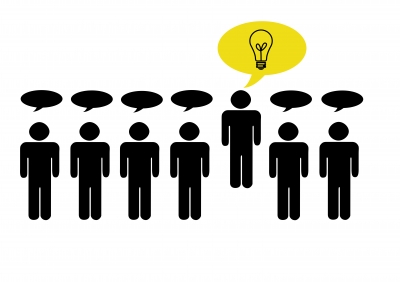
By Africa. freedigitalphotos.net
It seems to me that the proliferation of know-it-alls (I have to include myself, unfortunately) in world culture is directly traceable to the rise of Wikipedia. There’s the obvious point that we can get information on almost anything at a click, but there’s also the less obvious inference from the fact that it’s crowd-sourced.
Anybody can add his/her two cents worth, or so the myth goes. That may have been true at the inception, but try it now, and see how far you get. That whole wisdom-of-crowds thing got a pretty good thrashing, as it became clear in the early days of Wikipedia that a lot of garbage was being put up. Eventually, the Wiki-editor was born, and now you need credentials to post, or even revise.
But the myth lives on, and the prevalent, if dubious, implication that one opinion is as good as the next. Politically attractive as such egalitarianism is, it just ain’t so. Ironically, everyone seems aware of this in regard to someone else’s opinions; we’ll have to look elsewhere for the root of our narcissism.
The other part of this illusion of expertise is the instant accessibility of information. This goes back to a very common misconception of long standing: the idea that an expert is nothing more than a repository of data. There have always been two stereotypes of genius. On one side is Einstein, standing before a blackboard filled with utterly incomprehensible symbols, and on the other is Ken Jennings, the record Jeopardy winner. To me, the two represent complementary aspects of genius: Jennings the large working memory, and Einstein the ability to see patterns and implications. Somehow, in the popular mind, this has gotten reduced to access to large databases. Presumably, in this view, Einstein simply knew the encryption key which made all those facts available to him.
A recent cartoon has a character saying, “I’ve outsourced my memory to Google.” Would that it were so simple. Having all that information accessible in your brain is inherently different from being able to look it up quickly on your computer. It is where the Jennings and Einstein stereotypes merge; you simply cannot see the pattern in a dataset if you can’t see the dataset all at once, and that requires a large working memory, inside your calabash, not on your desk. Worse yet, you can’t see the fallacy in any given proposition if you can’t quickly compare it to other propositions.
My students used to ask me how you can choose between two plausible, but contradictory propositions. Well, googling it will not help. You need to closely examine the underlying assumptions of the two ideas, as well as the implications. You also need to see how compatible they are with other propositions. This is possible without a good working memory, but very difficult.
Much easier to pick a side, and stick with it. You see this mirrored all the time in online “discussions.” A makes an assertion; B makes a counter-assertion. From that point, it’s either alternating re-assertions, or ad hominem, frequently both. There is an appalling scarcity of any relevance from one comment to another. If an adversary’s point is acknowledged at all, it is only as a prelude to insult. “You say x; you’re hopelessly naive.”
Internet knowledge is very broad, but shallow as a puddle, I’m afraid. Add to that the fact that most search engines will give you what the algorithm says you want, and online genius can be summed up in one word:
Fool.
 Omniop