
A post for Military Day

As a veteran, and certainly not a hero of any kind, I am increasingly frustrated by the complete lack of understanding of military life by people who never served but who profess to honor it.  Apart from the obvious (if you think so highly of it, why don’t you join?), there is the near deification of soldiers, regardless of what they have or haven’t done.  Heroism is, by definition, a rare thing; to me, calling everyone a hero erodes the accomplishments of the true heroes, of which there are but few.  “Beyond the call of duty” means just that.  You don’t get to be a hero by doing your duty, however dangerous and however rare such a thing has become these days, when few even acknowledge that it exists. Never mind that the military has the same percentage of scoundrels and backstabbers as the rest of the population.

But enough preaching.  Here’s a little story about the military which I think hints at the real nature of soldiers everywhere.

Years ago, when Fort Benjamin Harrison was still a functioning military post, I happened to be passing through Indianapolis and stayed at a motel on the Eastern outskirts of the town.  It was one of those places that offered a free “continental” breakfast: cheap, sugary puffers the like of which the continent has never seen.  But there was a small group of National Guard soldiers staying there, on their way to weekend training, and soldiers never pass up free food.  They filled the breakfast area while I was swilling down bad coffee the next morning.

At one point, a young woman stood up and introduced herself as Sergeant Johnson, their guide to Fort Harrison, since apparently most of them had never been there.  In a typical crisp military vernacular, she proceeded to delineate a long and complex series of instructions on how to get there, complete with road intersections, traffic lights, and, in one case, UTM coordinates.  As she finished and sat down, a young lieutenant near me turned to his companion, an old, grizzled sergeant.

“You get that?” he asked, in his best command voice.

Yes sir,” the sergeant replied, “Follow Sergeant Johnson.”


Wilderness revisited

It’s a crazy world.  The other day, I decided to go for a walk; it was the first gorgeous day after a period of rain, and utterly irresistible.  I ended up at the city library, one of those Carnegie structures so ubiquitous in small and medium towns across America, a millionaire’s atonement for ravaging society, back when such people even cared.  This particular one sits in a little park with a bandstand and a monument to a parents’ grief for their soldier son, killed in action.  It has the added virtue of offering coffee from one of those Keurig pod machines for fifty cents.  Pretty good coffee, too, and you get entertained by the myriad characters that hang around such places.

It was, as I said, a beautiful day, so I took my coffee outside, to sit by the fountain donated by another benefactor to the glory of his family.  It was windy, so it was just as well the fountain was off.

Just as I settled in, I heard an animal running somewhere behind me, a large dog, I thought.  As it passed in front of me, though, I was startled to see a young deer bounding headlong toward the midday traffic.  It’s not a huge town, but the streets along the park run to four lanes, and I worried that the deer wouldn’t make it without getting pancaked against a cement truck.  No problem.  In a flash, it cleared six lanes, including a side street, and disappeared into an adjacent church parking lot.

Now, those with a mystical bent might see an omen of some kind here.  Me, I just reflected on the fact that our town, these days essentially just a suburb of St. Louis, has grown very rapidly, outstripping its sleepy county seat days, and leaving nearby wildlife precious little room for, well, wild life.  Ironically, as habitat shrinks, so does the taste for hunting among the minions of the town, now pretty much gentrified and unused to killing their own food.  Canada geese, which used to pass here twice a year during migration, now stay year round in the many ponds dug for all the wilderness-sounding suburbs (Iron Mountain Lake, Notting Hills Forest, etc.).  People complain about the scat, but eating the birds is illegal, so they thrive.  As do wild turkeys, of all things, frightening toddlers in their own yards.

This is happening all over the country, as demographic studies continue to show the increasing urbanization of America.  At least we don’t have bears where I live; that would, indeed, be a portentous omen.

I suppose the upshot is that wherever you might find omens, there is usually a practical element involved as well.  I’m reminded of a student I had while doing archaeology on the island of Ithaka, in Greece.  It was, of course, the home of Odysseus, and we were at the foot of Mount Aetos.  My student, who was supposed to be paying attention to a prism pole he was holding, looked up and cried, “Hey, what kind of bird is that?”

I looked where he was pointing, to his left.  “It’s an eagle,” I said, “and it’s to your left.  According to Homer, that’s a bad omen.”

“Oh,” he said, and turned around until it was on his right.


Bucky

Another tale from my dubious youth.  As usual, the names have been changed to protect the guilty.

Among the questionable movements of the hippy era was back-to-the-land romanticism, sustainable only if you had a paying job that left you enough time to muck about with gardening, a grant whose results didn’t fall due for a few years, or parents who thought you were studying to be an engineer.  My friend, call him Ned, fell into the first category.  He worked as a construction laborer, a job he described as being a human mule, and which scrubbed a good many romantic scales from his eyes.  I remember someone telling him admiringly what a healthy life physical labor was.  When he asked what she meant, she explained that you always see these old men on construction sites, obviously of advanced age, but still able to do the strenuous work required, as opposed to aging men with sedentary jobs.  Ned patiently explained that those men were only in their thirties, they just looked old, worn down by lives of hard labor and dubious choices.

Nevertheless, Ned, an eagle scout, kept a romantic edge on the idea of self reliance, to the point that he rented a house in the country from a farmer who had moved into a subdivision, having tired of the “simple life.”  He diverted water from a nearby stream for his use in the house, and heated it with a wood stove (albeit a state-of-the-art Swedish one).  He also kept a kitchen garden, and raised a few goats;  by and by he acquired a cow.  Because he earned a reasonably nice paycheck from the construction industry, he was able to make a go of it without going bankrupt.

One of the goats was a young billy who was constant trouble.  He was particularly adept at escaping the pen and eating up all the produce in the garden.  Ned devised more and more complicated ways of keeping him in, which he always defeated.  To make matters worse, he delighted in charging the legs of Ned’s friends when they were about, earning him the name Bucky.  He was especially frightening for children, who had no height or weight advantage in these confrontations.

Eventually, Ned got tired of it, shot Bucky in the head with a handgun he kept for security, and announced there was to be a goat roast.  A friend who had read somewhere how to do such things offered to clean and prepare the goat for cooking, and Ned got on to digging a pit for charcoal and rigging up a reasonable facsimile of a spit.

The actual gutting and cleaning, along with the subsequent hide tanning, is a whole other story, fraught with missteps and near disasters, that I won’t go into here, as it eventually was successful.  Suffice it to say that I will never forget the taste of fresh goat liver omelet for breakfast as long as I live.

The day of the party arrived, and guests along with it.  I have to say, it was as varied a group of individuals as you will see.  There were hippies, academics, construction workers, and people from foreign countries, reflecting Ned’s multifarious interests and genuinely diverse community of friends.  Among the merry-makers was his current girlfriend, with her five-year-old daughter, whom we shall call Robin.

Beer flowed like … beer, and the country air was hazy with cannabis.  Everyone gathered around the pit, taking turns turning the spit and arguing about whether the goat was done yet.  It didn’t take long for Robin to figure things out.  In the midst of one of the discussions, she turned to Ned.

“Is that Bucky?” she asked, pointing to the sizzling roast.

Ned took a moment, no doubt turning over in his mind exactly how to approach the topic of death and the food chain to a five-year-old.  Eventually, he cleared his throat.

“Yes, it is,'” he said.

“Good!” she replied.


Hoops

Today, I walked past a public basketball court, one of those ubiquitous chain link and asphalt affairs. Three young men were shooting hoops, shouting and posturing, probably wishing for a fourth to show up, so they could get up a game of two on two. As an old fart, I was, of course, invisible to them. A couple in middle age took a hasty glance in their direction, then hurried by. Better safe than sorry, they seemed to be saying.

Me, I was unexpectedly overcome with a flood of memories, of childhood alleyways and pickup games. Where I grew up, every block had at least one goal attached to a garage. Sometimes it was a sturdy plywood backboard, sometimes, the plies had long since begun to separate, the hoop sagging forward at an inviting angle for attempted dunks. Sometimes it was just a hoop, nailed at an arbitrarily convenient height. There was almost never a net, although now and then, a new net would mysteriously appear, the talk of the alleys for at least a week, by which time it had already begun to fall into tatters.

The only relevant attribute among these places was the presence of other kids; it was nice to play at one of the better garages, but if there was a kid or two at a lesser one, that’s where the action went. The ownership of these places was equally unimportant. Some places were attached to known neighborhood kids, but others seemed relics of bygone days; only the ghosts of children played there. In any case, I do not remember ever being run off by an owner, though it must have happened.

The skills I learned at alley ball were not directly transferable to organized team basketball. The official courts were too big, requiring way too much running, and too smooth; the crucial skill of hitting the cracks in the surface just right when dribbling had no place there. The official balls were all the same size and uniformly inflated; no critical in-game adjustment for equipment was required at all. Worse yet, you had to use the ball provided, and couldn’t bring your own lop-sided, hyper-inflated ball, the one you practiced with so earnestly at home.

But by far the worse aspect of official team basketball was the presence of coaches and referees. In alley ball, kids learned to be fine judges of character and excellent negotiators, none of which was the least bit of use to referees, who always insisted on having the last word. They weren’t even interested in hearing the opinions of the players before making a decision, which was apparently based on inflexible rules which took no account of the immediate circumstances of the game, let alone who was playing.

And coaches, as near as I could tell, were concerned only with making you run around the gym while they yelled at you.

What that was good for, I’ll never know.

A man of his word

I’m sitting here in what could very well have been Southern Canada, but for a man of his word.

In 1778, the British controlled all of the Northwest Territory, comprising present day Indiana, Illinois, Michigan, and Wisconsin.  Their primary seat of government was at Detroit, and their method of enforcement was through alliances with local Indian tribes, who felt squeezed out of their ancestral hunting grounds by encroaching American settlers; they easily dominated the French who had previously settled the area to ply the fur trade, but failed to win their hearts and minds, and thereby hangs this tale.

With the encouragement of the British at Detroit, the Indians were regularly raiding settlements in Kentucky, then part of Virginia.  They didn’t need much encouragement, at that, since this had comprised some of the richest hunting and fishing grounds they had known, increasingly being divided and fenced off by Euro-American farmers from the East.  Naturally, this didn’t sit well with these same settlers.

Just a reminder: North America was in the throes of the Revolutionary War at the time, so any excuse for belligerence was more than acceptable.

I suspect the rebels in the East would have been prepared to write off the Northwest Territory; their armies had all they could manage as it was.  Fortunately, or unfortunately, depending on your point of view, a young officer named George Rogers Clark persuaded Patrick Henry, the governor of Virginia, to back a secret plan: Clark would recruit and train a militia of Kentuckians, known locally as Long Knives for their swords and bayonets, and they would advance on Kaskaskia on the Mississippi, just South of St. Louis, and from there take the lightly held French towns of Cahokia and Vincennes, the latter being the venue for this tale of intrigue.

All went according to plan.  In spite of having been able to recruit a measly 150 men, Clark took his objectives easily, primarily because of the element of surprise, and the fact that the French inhabitants didn’t much care for the Brits anyway.  He returned to Kaskaskia, satisfied.

But, word gets around, doesn’t it, and soon made its way to British General Henry Hamilton, the governor of the territory, at Fort Detroit, and he led a large contingent of soldiers South to Vincennes, and retook it.  Clark, back at Kaskaskia, had no inkling of this, and was in fact busy recruiting for a march on Detroit, where he would have easily been picked off by Hamilton’s troops from the flanks.

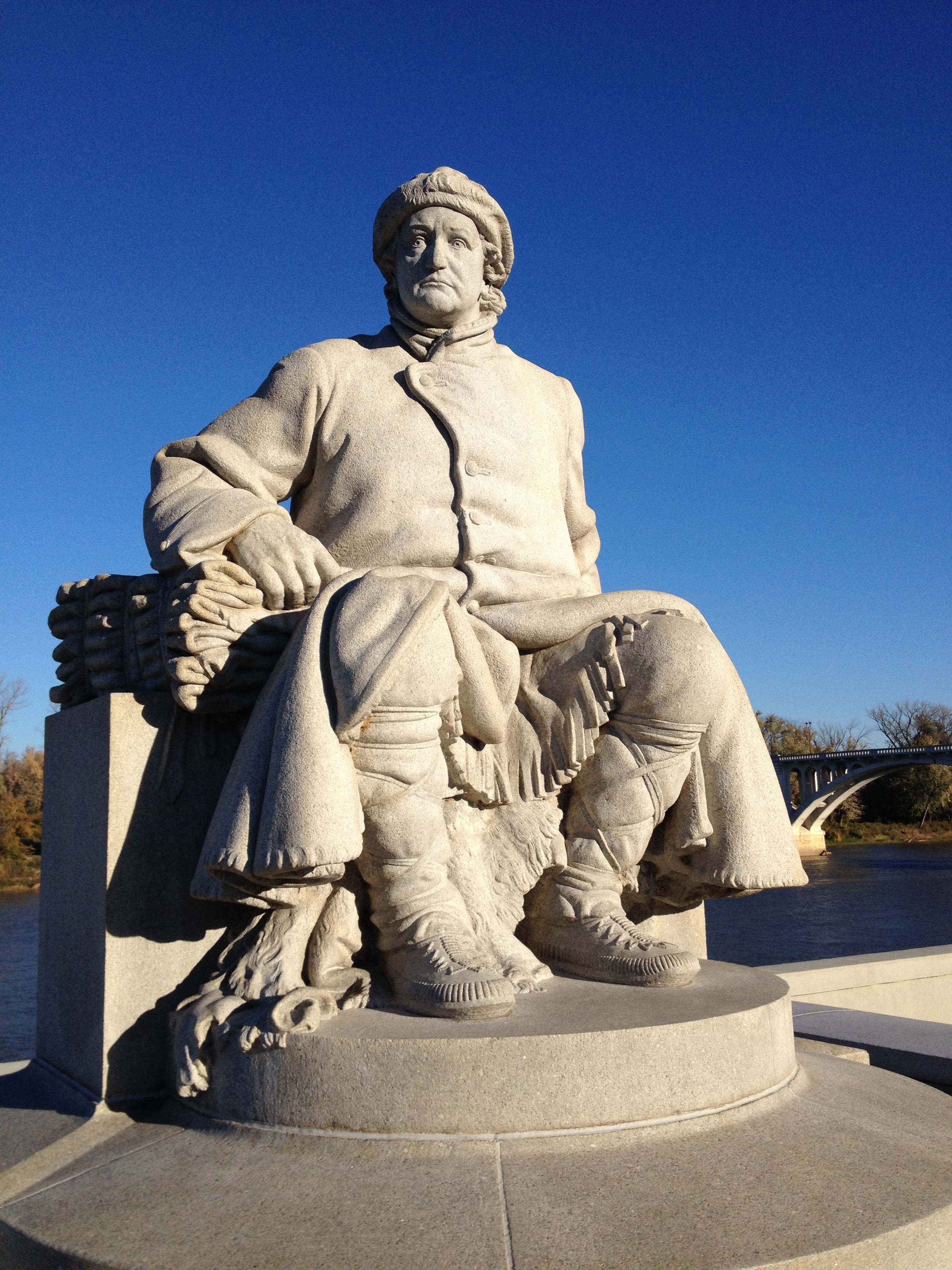
Enter Giuseppe Maria Francesco Vigo, a Sardinian and sometime Spanish soldier who had set up shop in St. Louis as a fur trader.  Vigo was at Vincennes, by some accounts sent as a spy by Clark, and by others on his own account as a fur trader.  Vincennes, Indiana is a sleepy backwater on the Wabash River today, but in the 18th century had been a vital link between the French interests in the Great Lakes and their colony at New Orleans, so his presence there was plausible.

In any case, Hamilton smelt a rat and had Vigo arrested before he could return to St. Louis. This didn’t sit well with the local French population, however, who threatened to withhold vital supplies unless Vigo was released.  Hamilton made the best of it by letting Vigo leave Vincennes, but not before extracting a solemn vow: Vigo was not to whisper a word to the Americans at Kaskaskia about the fact that Hamilton controlled Vincennes, on his way back to St. Louis.

And the thing is, he was true to his word.  He went down the Wabash to the Ohio, West to the Mississippi, then North to St. Louis without a word.  After which, he backtracked to Kaskaskia and spilled the whole story to Clark.

The rest, as they say, is history: Clark’s daring winter passage to Vincennes, so unexpected by Hamilton that he had sent most of his troops home until Spring, and the final victory, concluding with Hamilton’s surrender.  The Northwest Territory was ceded to the Americans by the Treaty of Paris, ending the Revolutionary War,  in 1783.

Thanks to a man who kept his word.  Otherwise, things might be a little different down here in Southern Illinois, eh?

IMG_0018

The man himself, himself.