Appreciation

26 June 1886

Mlle. Felicite Jenesaisquois
Chocolatiere to the Arts

Chere Mlle.,

Please experience the deepest ecstacy, such as that I have myself experienced this afternoon, while eating consuming devouring experiencing your most exquisitly sublime confections.  Since my gratitude is inexpressible, I shall no longer be able to continue our relationship.  Be assured, however, that I remain your most humble and contrite servant,

M. Jean-Claude Tressilly

The stamp man’s complaint

Janos was a good and dutiful man. He had a small house with a neat little garden plot overlooking the railway station.  He kept his petite wife well supplied with money for groceries, flowers, and other necessities.  And every morning without fail, he boarded the 7:10 into the center of the city, to report for work at the Bureau for Auxilliary Affairs, precisely at 8:00 AM.  His record was unblemished, save for the time he choked on a digestive biscuit and had to be taken to the clinic for treatment. He was 2 hours late that morning; it is possibly the reason he was passed over for promotion yet again.

Which is a damn shame, really. His job was to approve paperwork as it passed through his station. He was a stamp man, and possibly the best in his section, the Department of Supplemental Approval. The official rate of passage of forms to be approved through his station was 30/hr; he himself estimated it at more than 100. Theeoretically, he could mark any given paper with the bright red Returned fo Further Evaluation stamp, rather than the bright green A, but that slowed things down considerably, as he would have to fill out the proper form, and hand carry it along with the Returned paper down the hall to the Department of Approval Appeals. Janos considered this a waste of valuable time, as there was no one ever there. One dropped the papers ino a slot marked IN, and they disappeared. Meanwhile, paper at one’s own station was piling up relentlessly. Over the years, he had gradually come to simply approve everything that came through. That had been an immense relief, for it meant he no longer had to read the papers as they came through; indeed, truth be told, he had forgotten the criteria for approval, or even the nature of the forms themselves. Perhaps that accounted for his legendary efficiency. Janos’ days passed smoothly and inevitably. He was happy, and his superiors were happy. Though not so happy as to promote him.

And so, in the course of events, came this particular day, which to all appearances differed not one whit from any other day.  It was also a day Janos would regret for the rest of his life.  For it was the day he glaanced down at a form before stamping it.  He read,

milk
bread
1 ib butter (unsalted)
tea (Elina’s favorite)

It was, truthfully, not what he expected. True, he was no longer sure what the paperwork was about, but this seemed unlikely. With a hint of a tremor, he reached over to the top of the pile to his left, the already approved pile, and nervously looked at the top, most recently approved paper.

Dearest Sylvia,
I can no longer be responsible for the fire in my heart. I dream constantly of your warm white breasts, the razor-like nipples piercing…

He had read enough. A cold hand gripped his heart. It must have been a quarter hour before he slowly returned his attention to the pile. With each paper, each word, his heart sank further into his shoes.

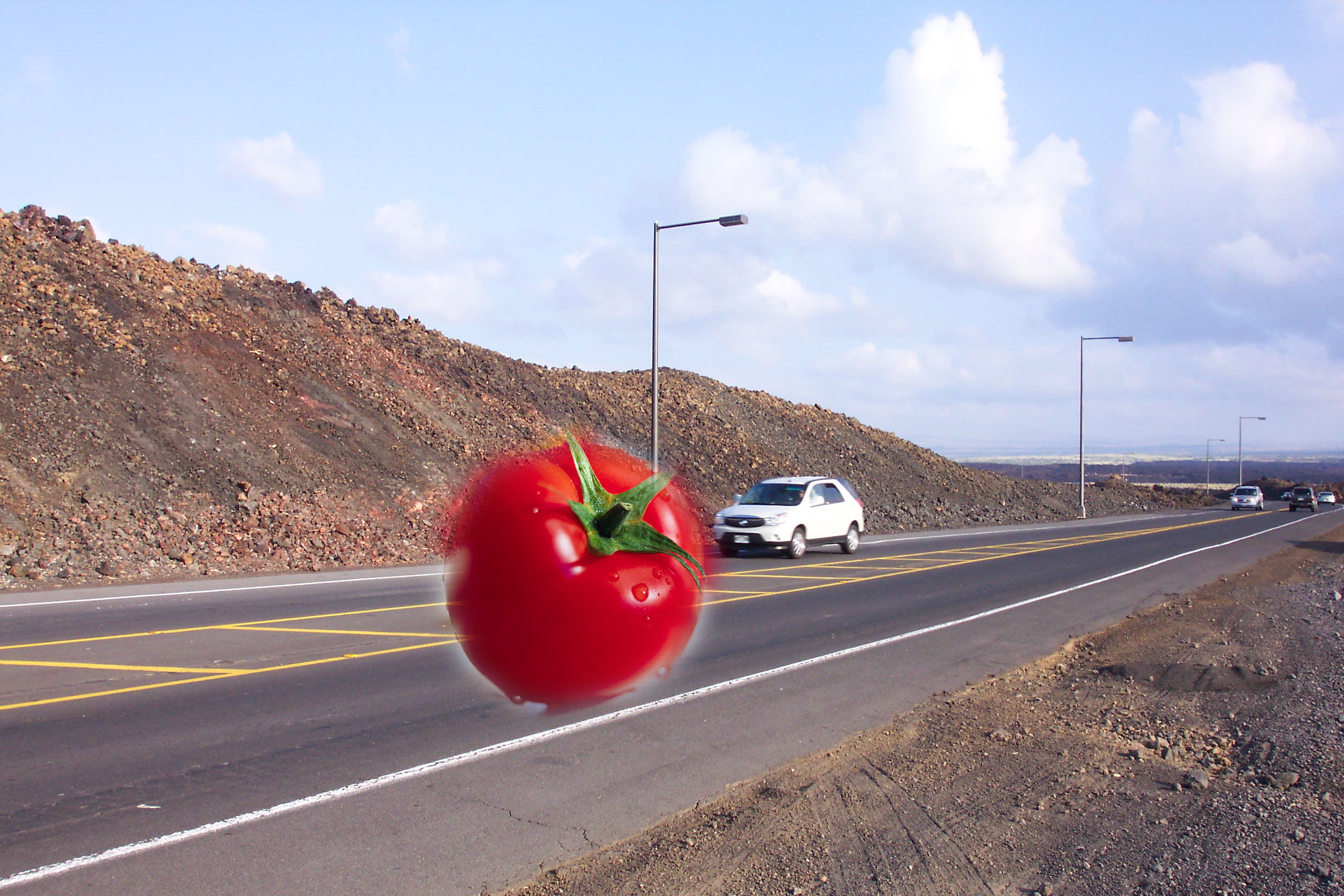
Deadly tomato touches down in Hawaii.

This photo shows a deadly Category 4 tomato touching down Near Kona, Hawaii.

100_1389 copy

Report 12a: Other interesting species

The dominant species on Planet X is, like us, exoskeletal in structure, with a strong centralized information/analytic core operating over numerous individual foraging operative units, again like our own configuration.  This should not be surprising, as all of our projections have strongly suggested that this is optimal for species to progress intellectually.  This species, or more accurately, array of species, in the native taxonomy, is designated Blatta or Blatella, colloquially cockroach.

However, there are several other life structures more or less successful on the planet, most of them part of the Blattoid survival system, but still of interest in their own right.  The closely associated Homo genus is particularly fascinating, as it has developed a kind of neuronal autonomy, all while fulfilling its primary function as Blattoid food aggregator.  This neatly illustrates the principal of progress within dominance driving progress among subordinates as well.  The benefits trickle down, as it were.

This group is a part of a large subgroup of life that has internalized skeletal structures, strange as it may seem that such an adaptation could survive the rigors of planetary change.  No doubt it was successful only due to its usefulness to the more abundant exoskeletal populations.  The internalization process appears to have been more general as well, since most species live outside the protective and nourishing saline water environment; they have evolved a means of carrying these essentials within them.  Not terribly efficient, one might argue, but there they are.  Indeed, the Blattoids themselves largely live outside water, as well.

Homo is a very homogeneous genus, having survived a major killing episode some 2,000 generations earlier as a single breeding population, or at most 2-3 such populations in close contact.  The only extant species is the sapiens sapiens variety, others having died out.  As a result of the extremely short breeding history since geographic expansion, they are a remarkably uniform species genetically, differing only by tenths of a percent.  Nevertheless, much appears to be made of such trivial differences as can be identified, perhaps as a mechanism to evolve to accommodate diverse Blattoid species;  more study is required, since this tendency is dysfunctional.

Perhaps the most curious attribute of Homo is the complete decentralization of species intelligence.  Instead, each individual carries its own ideational complex built upon a central nervous system; so specific is this center, that if the head, where it is located, is removed, the individual immediately shuts down, and is therefor incapable of fulfilling its role in the species from that instant.

The explanation, of course, of such an unlikely array of evolutionary elements is in the role of Homo in service to Blattoids.  Such extreme self-containment suddenly makes sense when seen as a response to the diverse situations in which roach populations find themselves; with primary food aggregators able to act spontaneously and autonomously to procure proper Blattoid habitats, any unforeseen problems can be easily averted.

The committee hopes  this study will be helpful in making full contact with the dominant intelligent species on planet X; it may well be simplest to proceed through the intermediation of their Homo servants, as unpalatable as that may seem.  Actually, though, they may be quite palatable, once their usefulness to us is ended.
Open letter to the Director, Department of Intelligent Design

Dear Sir,

It is my belief that, the prototype having been in production for some 6,000 years, some issues might be addressed which have come to my attention.

First, although it may have seemed a good idea at the time, it is increasingly clear that it was a mistake to make the universe seem so much older than it really is.  I was not present at the meeting when this was discussed, so I cannot say what the purpose may have been.  There has been talk of some sort of test to be administered to a transient species near the end of the process, but it now seems rather a lot of trouble to have gone to, for what could only have been some sort of joke.

Second, I thought it had been agreed that the order and harmony principles behind the design would obviate any further tinkering down the line.  It now seems that suspension of the rules which govern things is so frequently required that there is even a name for it: “miracle.”  I don’t suppose it occurred to whomever authorized the first miracle that it would set off a chain of events requiring more and more of them as more time went by.  Can you say butterfly effect?  I understand it has even gotten to the point where sporting events can no longer be decided without intervention.

Third, biology.  I don’t know where to start.  Who was in charge of biology?  I mean, it started out fine, lots of diversity there, plenty of fun, but did somebody go on vacation, or what?  I get a column with four protrusions.  Nice symmetry, good locomotor possibilities, sound basic engineering.  But why stand it up?  Do that, and the load structure goes all wrong, you get joint issues, and the column goes all to hell.  ME 101.  Hell, might as well just have evolution if we’re going to be that sloppy.  And don’t even get me started on bacteria; they’ve got security issues you could push a planet through.  We need a change of leadership there, for sure.

Fourth, and in my opinion, most disturbing, we seem to have pushed all our error down into the nano level.  I completely see the reasoning behind this: sweep it under the great cosmic rug, and hope nobody trips over it.  But they will, you can count on it.  Already, people have found out that we’ve got stuff popping in and out of existence down there all the time to keep things in balance, and they’ve been poking around anti-this and dark-that for years.  It’s only a matter of time.  (Sorry, couldn’t resist)

I don’t mean to be an alarmist, but I hope there is still time to address these issues.  I know, we can always create more time if we run out, but is that really the right way to run things?

With all due respect,

God, Sr. (Retired)