Where we’re at

While it’s true that being appalled by Trump is terrific sport, we should be careful not to let it overshadow what’s going on policy-wise in the meantime. Trump’s appointees are quietly trying to implement an agenda that the right has been craving for years, but has been unable to deliver in the light of day.

There’s a limit to what they can do, thank goodness. Many of the regulations of the EPA, for example, have been encoded into law, and are beyond the reach of the executive branch alone. We can be grateful for the incompetence of the Republican congress.

They’re also hamstrung by Trump’s infantile rants, or rather by calls to condemn them. You’d think it would be a simple thing to respond to the atrocious statements coming out of the WH by just reiterating statements members of the Republican party have said many times before, but the problem is that they don’t want to risk alienating Trump for fear of halting the afore mentioned slow, stealthy march of the right-wing agenda by his minions.

They’re walking a delicate line. If they let him go too long, the risk becomes losing control of congress, but if they stand up to him too soon, they risk derailing the progress toward conservative policies they’ve been lusting after for years.

Many years ago, when I ran a crew of surveyors for a couple of penny-pinching bosses, the crew truck I was driving broke a front axle at 60+ mph on the highway. I managed to coax it to the shoulder, and called my boss. I told him what had happened, and that the right front wheel was barely hanging on by a tie rod. He said, “Could you nurse it home?”

The wheels are slowly, steadily coming off the Trump administration truck, one at a time. I have a feeling that congressional Republicans are just trying to nurse it home.  Disaster, from their point of view, is almost inevitable.  I’m mentally preparing myself for the pleasures of schadenfreude.
Lumps in the gravy

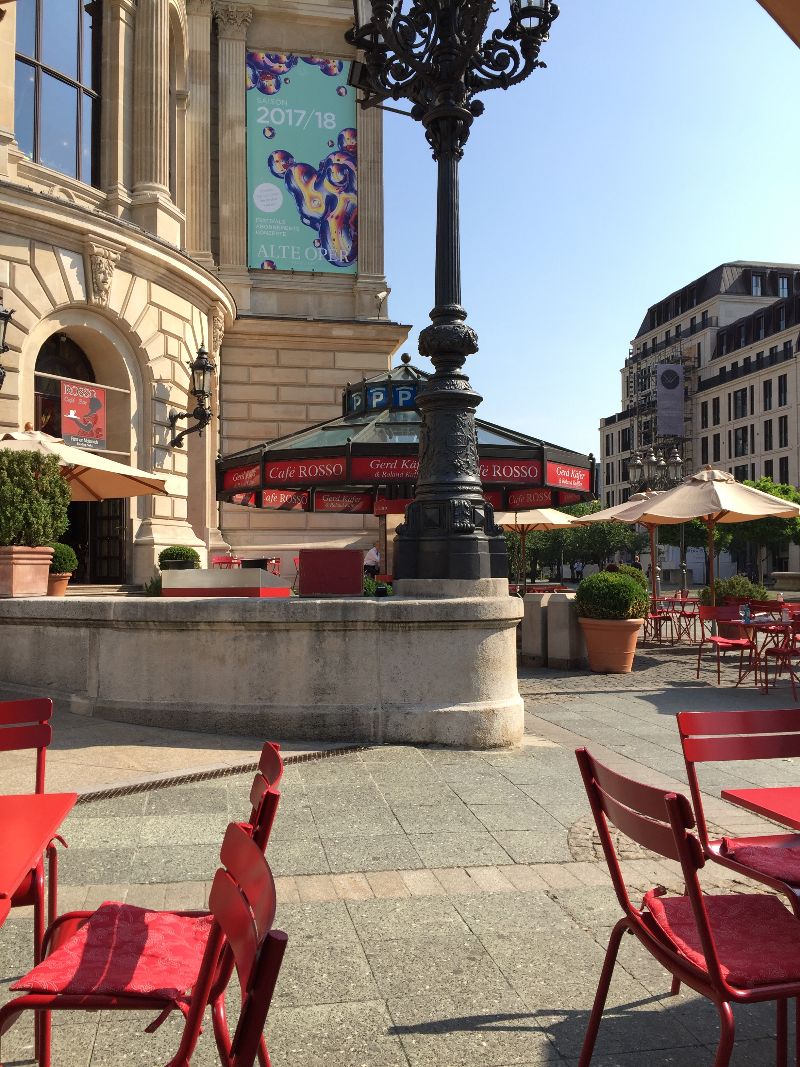
A café at the Alte Opernplatz

I just spent a couple of days in Frankfurt, Germany. I had been stationed there some 50 years ago, and since I was passing through on my way to Riga, I jumped at the opportunity to see how much it had changed. The late 60s, after all, were not all that long after the end of WWII, and Frankfurt, like much of the rest of the country, had been bombed into rubble; the few buildings left standing in 1945 were left on purpose, the allies having singled them out for future headquarters. A lot had been rebuilt when I was there, but although the rubble had been pretty much cleaned up, a lot had not. Whole quarters were still clear of buildings, including the historic Römer, one of the most important sites in German history. A few blocks away, the old Opera house was standing, albeit unused and unsafe, with rows of chest high bullet holes along its walls. There were similar reminders of the war all over town. All of that has now been rebuilt to exacting specs, and the city was eerily unfamiliar within a context of remembered places and new construction.

But the most striking thing was the population. On certain streets it was nearly impossible to find a bratwurst among the curry and halal restaurants. What I found was a vibrant diverse community of people living peacefully together.

Well, that’s not all that odd for Frankfurt. When I was there 50 years ago, we used to joke that it was the northernmost Italian city in Europe, with strong Turkish and Indo/Pakistan contingents as well. Still, Germany?

It is, after all, practically the birthplace of the very idea of the ethnic nation state. Those Mediterranean peoples I remembered from all those years ago had been invited in as guest workers, and Germans were pretty ambivalent about their presence.

Things are very different now, thanks largely to the efforts of Angela Merkel to keep the borders open to refugees from the many devastated parts of the world. There is resistance, of course, and a resurgence of the right, as in many other places in the west, but, at least so far, its impact has been rhetorical for the most part.  I have heard Americans say that Merkel has ruined Germany, by which they mean she has ruined it for people like them, racist xenophobes.  I agree, and I hope it stays ruined for them. Germany, of all places, is something of a beacon of hope in a dismal political landscape.

Which brings me to America. What an embarrassment. We strut and crow about melting pots, but when the chips are down we fold and curl up in a little ball. Not all of us, of course. I am happy to say that more than half the country fully and proudly stands for and lives up to the noble sentiment inscribed on the base of the Statue of Liberty.

Unfortunately our cynicism has allowed the minority to elect a government headed by an appalling racist and a congressional majority too terrified of the loss of power to stand up to him. We of all people should be an example to the world of compassion, but we’re not.

I mean, Germany. Who would have ever thought it?

A rear-view mirror is still a mirror

People say all the time that they have no regrets.  Me, I’m practically defined by them; a man with no regrets is a man with no imagination, as far as I’m concerned, and I say that all too often for people around me, I suspect.  Still, I confess I’m mystified by people who essentially admit they can’t think of anything in their past that could have gone better had they made a different decision.  Equally, I fail to understand the virtue of still being the same person you were 40 or 50 years ago.  As Muhammad Ali said, someone who has the same opinions at age 50 as they had at age 20 has wasted 30 years of life.

Maybe that’s why, now that I’m old, I have this strange compulsion to revisit my life, to retrace my steps.  I’m drawn to places, both actual and conceptual, I passed through on my way here, to physically visit them, to stand in my own footsteps to see — what?

It’s not at all clear what it is I’m looking for, certainly not a glimpse of myself as I was then; that’s a vision that’s all too clear.  Nor is it primarily an attempt to reconstruct what I was thinking, to re-find or redefine whatever it was I thought I was doing, although that would certainly be interesting.  I’m not looking for redemption, or even a rationale.

Part of it is to correct the unconscious revisions I have made to my own history.  I’m sure you’ve had the experience of reconnecting, after many years, with an old friend or acquaintance, only to find that there are at least two contradictory versions of some common experience.  These things are seldom resolved, though.  We generally each come away wondering how the other person could have gotten the memory so wrong and yet be so sure.  It needs a new term to describe these common events.  How about “memoroid?”  I think that has enough innuendo hanging from it to serve the purpose.

No doubt what I’m looking for is a lot closer to hand and a lot easier to get at than a precisely calibrated reconstruction of the past.  See, I don’t think you can have a realistic assessment of who you are without a clear picture of who you were.

That gets both more and less difficult as you get older.


A somewhat immodest proposal

We Homo sapiens have been around for at least 250 thousand years. The first hints of agriculture appear about 12 thousand years ago, or just under 5% of our existence in our current biological configuration. We’re still evolving, of course, but it’s a slow process, and it’s reasonable to think we’re not much different from those earliest farmers, who were essentially hunter-gatherers with a fancy new startup.

For the majority, then, of our existence, we made our living hunting and gathering, which limited the size and distribution of us. Conditions differed from place to place, of course, but, as a rather small total population, we weren’t in that many different places for a very long time, so those limitations tended to average out and produce groups of 50-200 or so individuals spread rather thinly on the surface. Too many people meant not enough to eat, so a sensible strategy was to avoid other people whenever possible; not all that hard in the beginning.

One way or another, though, we figured out that it was best for us to get marriage partners outside our own groups; how and why is a contentious issue among anthropologists.  In any case, it meant that groups needed to stay reasonably near each other.

It’s not hard to see the awkwardness caused by these two competing strategies. On the one hand, we were congenitally suspicious of outsiders and wanted to either drive them away or kill them, while on the other hand we needed them to procreate. What to do?

The answer was to limit our interactions with other groups in general via warfare or other hostile behaviors, while consolidating our relationships with one or two select groups via intermarriage. Brilliant!

In my opinion, the spread of farming once it was discovered was due to this dynamic of wanting to get away from other people while simultaneously seeking marriage partners among relative strangers. We see this time and again, even explicitly as excuses for expansion, from elbow room to lebensraum. It also explains the intermarriage of European nobility; it’s not that they found each other so irresistible. In a sense, it’s just scaled-up hunter-gatherer strategy.

Which brings us to my proposal. Donald Trump, are you listening? Your son, Barron, is, what, 10 or 11 now? Through most of history, that’s plenty. The great statesman and diplomat Dennis Rodman tells us that Kim Jong-un has a daughter named Ju-ae, who would be about 8 or 9.

I think you can guess where I’m going with this.

Le Juif Errant

Mikels Skele's avatarOmniop

For the end of a week in remembrance of the Holocaust, I am offering up this post of mine from a couple of years ago.

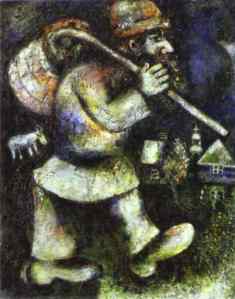
the-wandering-jew-1925 Le Juif Errant, Chagall, 1925

When I was a boy, I developed an aversion to the art of Marc Chagall.  Why?  Because some of his work was used to illustrate a catechism we were tortured with in St. Philip Neri School.  I had no way of knowing at the time that St. Philip himself, a notorious iconoclast, would probably have flung the damned book out the window if we found it distracting.  After all, when one of his monks came rushing to him all aglow with the news that the Virgin Mary had visited with him while he prayed, he advised him to spit in her face the next time she disturbed his meditation.  Had I known, I might still be among the faithful, but…

View original post 846 more words