Ah, youth

Another tale from the annals of my splendidly misspent youth.  As usual, I have changed the names, out of a rather quaint sense of propriety.

Well, there we were, the lot of us squeezed comfortably into the crevices of a small, 5th floor pension a block from Plaza Cataluña in Barcelona.  What did we expect?  When you’re young, love blooms early and often, or at least what passes for love, some combination of lust and infatuation, I suppose.  Mother Nature gives us a double shot of hormones to get us making more of ourselves before we get distracted by life’s illusions.  For ordinary mammals, this is pretty straightforward; for us humans, anything but.

The Pension Fontanella was, above all, cheap, and the landlord easy going.  For 50 peseatas a day, about 75 cents in the exchange rate of the day, you got a bed in one of a half dozen or so rooms with anywhere from two to six beds each. In the morning was an included breakfast, of endless coffee, scones and butter, sometimes jam.  For another 30 pesetas, you could go down the street a ways to the worker’s cafeteria and get an enormous midday meal consisting, typically, of a giant bowl of paella, a grilled meat and potatoes course, and flan for dessert, all washed down with a Coca Cola bottle filled with cheap Spanish wine.  We thought Europe on $5 a Day, a popular guide book at the time, was woefully extravagant.

I won’t say the Pension Fontanella was a den of iniquity.  It was 1970.  The world was in one of its usual celebrations of youthful exuberance to accompany the coming of age of a postwar cohort, and the horrors of AIDS were nowhere on the horizon.  There were drugs, yes.  The landlord doubtless shared a portion of his profits with the local Guardia Civil.  It was 1970.  Mostly hashish, taken with a kind of connoisseurship: Moroccan blond, versus Lebanese red, etc.  Personally, while I had indulged lavishly while in military service, I had lost interest since my discharge.  I had come to find that while the first half hour or so of getting high was pleasant enough, after that I would often want to do something, and the hash haze became an obstacle.  Take whatever that says about the military as you wish; it was a different institution back in the days of Vietnam and the draft.

Anyway, as I said, there we were, merrily hopping from hash to hash and bed to bed, all bedazzled by the sheer possibility of life, blissfully ignorant of folly and its curses.  We played music; I imagined myself to be a competent guitarist and passable singer, mostly because of my friend Sid, who was so brilliant that when we played together, it made my amateurish thrashing about sound like intentional rustication.

Then, in walked Inga, and set it all a-tumble.

She wasn’t exactly beautiful, though her features were regular enough.  But, musically, she was head and shoulders above the quotidian, workmanlike talent we were used to.  It was the way she sang, with her eyes, gliding atop the effortless guitar lines with a sublime inevitability.  She made the trite seem fresh, and the fresh seem stunning; most of all, she made it seem personal to every male listening.  I was smitten.  So were we all.

She had arrived in the afternoon from nowhere in particular, and half the denizens of the pension sat far into the night under the spell of her singing and playing.  I fell asleep with the resolve that, in the morning, I would find her, and away from the rest of her admiring audience, I would have a chance at connecting.

Well, morning did come, and I found her, but not alone.  There she was at the reception desk, guitar and backpack all cinched up and ready to go.  Next to her was Billy, whom I had come to consider a good friend.  They were checking out.  Together.

Blap!  Just like that.  I lost my moorings.  I stammered a “good morning,” and asked, “What’s going on?  Are you leaving?”

“Yeah, Billy said, smiling broadly.  “We’re heading for Ibiza; the boat leaves in an hour.”  Inga beamed radiantly.  I was crushed.

“I gotta go,” I said lamely,  I could feel their quizzical stares as I headed for the staircase and out the door.

Well, it’s an old story, I guess, ruefully celebrated in many a folksong:

For courting too slowly you have lost this fair maiden
Begone you will never enjoy her
I once loved a lass

I walked down the street to a pub we occasionally patronized for special occasions.  It’s bar, lined with tapas the length of it, was a major attraction that outweighed the price of the beer.  Inside, I found Will, Sid’s brother.  He looked up and saw my face.

“You too?” he said.

I nodded and let out a sigh, and sat down next to him.  It was beer and calamares for a long, long brunch for us.  Not quite equivalent to true love, but it would have to do.
Killers

John Coyote has written a raw and powerful poem, Killer on the Road, about being a soldier.  The style is terse, the language rough.  The odd grammatical lapses, whether from art or habit, lend the poem a particular ragged urgency, like the sharp edge of a rusty piece of scrap metal.  This comes just in time for the latest debate, about whether or not to bomb something, anything, in Syria.

We suffer no shortage of moral pronouncements from either side, each more strident than the last; Coyote gives us something more precious, and far more useful: a portrait of a human being caught in the crosshairs.  In fact, it’s two human beings, caught in each other’s crosshairs, colliding, willy-nilly, in a reality of neither’s choosing.  For once in our most recent polemics, we see the enemy,  a suicide bomber, in his full humanity:

They killed his brothers.
They came to his country and torn it down to rubble.

He believed in a eye for a eye.
He will be in paradise soon.
Tears fall from his eyes as he think of his wife sleeping alone.

Suddenly, the suicide bomber is no longer a symbol, a cause, but an ordinary man, steeling himself to do what he believes he has to do, however delusional that may be.  Coyote makes no excuses here, pushes no particular agenda.  He simply points us to a reality we routinely choose to ignore: beneath the bomb filled jacket beats the heart of Homo Sapiens, one of us.  It doesn’t mean he’s justified in his actions.  It’s a mirror, pure and simple.  This is not a particularly new insight; battlefield correspondence from soldiers down through the ages reveals the same.  What’s new here and now is the permission to see it while we are still engaged in the conflict.  The soldier who, reacting instinctively to a threat, kills this man, ends up looking into this mirror, too long, perhaps, for his own good:

He hold pictures of a man’s wife  with two children.
He wonder why he has to kill this man?

He should of been home tossing a football with his brother or something.

He cries for the Iraqi he killed.
Old Sargent said he was a hero.

At this point, it’s too late for redemption:

He would do his duty and go home.
He don’t talk of God or Jesus anymore.
He just wishes for the blood to leave his hands.

There is no happy ending here, no satisfying resolution.  Scales drop from the eyes, but a lot that’s good in human values drops with them.

It’s a picture we need to hold onto while we’re making decisions that can kill not just bodies, but human spirits as well.  Coyote is clear about where he stands: stay home, no more killing.  Others might come to a different conclusion; there is the matter of precedent concerning chemical warfare to consider.  Either way.  Just let’s go into it with eyes wide open.

A little perspective, please

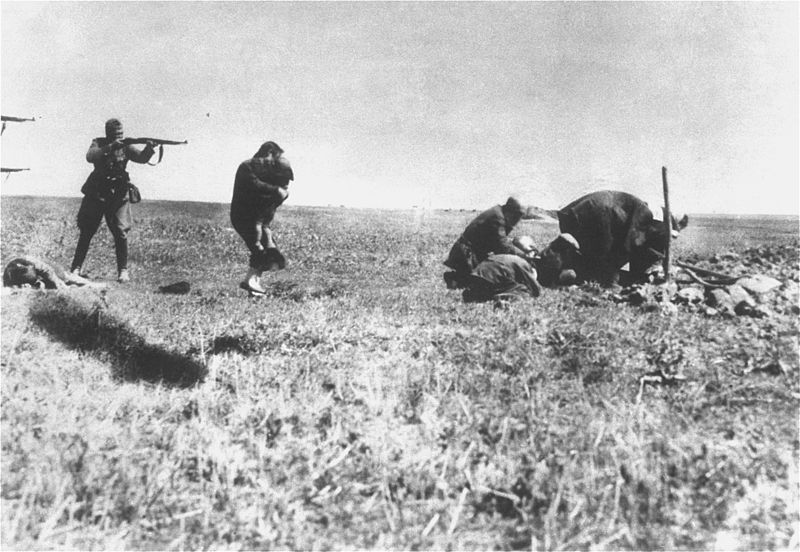
Jews being executed at Ivangorod.  Source: Wilkimedia commons

Jews being executed at Ivangorod. Source: Wilkimedia commons

I see a lot of gloom in the public literature lately, the idea that we have come upon horrible and chaotic times, the like of which have not been seen in recent history.  Certainly, some concern, even alarm, is justified, especially where global climate change is concerned, and I wouldn’t hesitate to acknowledge the seriousness of various international crises, especially those in the Middle East, but let’s step back a bit and take a deep breath.  How is humanity really doing these days?

Look, I’m no Pollyanna.  We’re not in Utopia, folks, I understand that.  And I fully understand the literary bias towards the dismal.  Doom looks more serious than optimism, pessimism is often mistaken for clear-eyed realism, and both are so attractive to writers facing a blank page that it’s no wonder how often they succumb.  I even approve of the role of writers as coalmine canaries, carriers of unpleasant but necessary information for the welfare of the society.  What I do object to is the increasing surrender to despair and bitterness (ahem, poets).  This abjectness is understandable for the victims of the various disasters occurring around the world.  It is inexcusable from people who, consciously or unconsciously, present their work as a sober reflections on reality.

Compared to the 20th century, the 21st, so far, is a cakewalk.  Are there wars springing up everywhere?  Not anything like World War I, in which 18 million lives were lost.  Soak that up.  18 Million.  But that was a drop in the bucket compared to World War II.  Estimates of fatalities in that war range from 60-85 million, about two thirds of which were civilians.  In addition to the roughly 6 million Jews that were fried in Nazi ovens, at least that many non-Jews were also executed: Roma, homosexuals, socialists, Catholic clergy, even persons whose great crime was that they were handicapped.  Not just in the line of fire.  All these people were systematically rounded up and executed, like so many floor sweepings.  Humans.  Mothers, fathers, brothers and sisters.  I often hear people sigh and wonder at the apparent inability of Africans and Arabs to live in peace.  They’re amateurs, compared to Europeans.

Let’s not forget the two major revolutions in the last century:  Russia and China.  In the Soviet Union, it is estimated that more than half of the 20-30 million casualties attributed to World War II can be tied to purges and forced mass migrations instigated by Stalin to rid himself of elements he considered disloyal.  The modern troubles in Chechnya and other hotspots in the Russian Federation can be traced directly to this.  Huge masses of native Chechens were moved out, and ethnic Russians moved in to replace them.  The gulags were full to bursting, in unspeakable conditions:  sawed-off oil drums as indoor latrines, little or no heating.  Often, inmates would waken in the Siberian morning with their hair frozen to the wooden pallets they slept on.

Let’s not forget diseases.  Horrible as the AIDS virus is, it’s not anywhere near as deadly as the 1918 flu epidemic, which infected about 500 million people worldwide, and killed as many as 100 million of them, almost 5% of the world population.  This came on the heels of World War I, whose charms I discussed above.

I could go on.  China’s revolution held its own horrors, including the Red Guard madness of the 1960s.  I won’t even start on the psychological damage attributable to the Cold War, and its policies of Mutual Assured Destruction, an apt acronym if ever there was one.

So why all the doom and gloom now?  Maybe it’s the instant and constant access to the global if-it-bleeds-it-leads news media.  Maybe, in the case of the US, where we seem convinced that not only is the world coming apart at the seams, but all our politicians are either evil, crazy, or both, we’ve grown so used to comfort that our greatest fear is losing some, even any, of it.

On being tall

Damn!  How short are you?

How’s the weather down there?

I bet you were a jockey in high school.

Say, would you mind getting something for me off that bottom shelf?

Wait, lemme put my foot up’side yours.  What size shoe do you wear?  That’s some tiny feet!

Up in front!

Hey, little guy, wassup?

For the record, I’m 6’5″ and wear a size 16 shoe.

There’s always time to reassess your reassessment