What I think I believe: A prose poem

To say there is no duality is to concede there is.

To say God has a list is ignorance.

To say you know anything for sure is naive.

To believe in a separate, personal God is nothing short of ridiculous.

Every religion tells us that God is immutable, omnipotent, and utterly ungraspable by the human mind.  Every religion goes on to tell us exactly what is in the mind of God.

Do you think your one, holy, catholic and apostolic church has droned the same immutable message since it rose from the ashes of the Roman Empire?  Do you really believe your free-thinking, free-wheeling nihilistic Buddha is the same one who sat, perplexed, tormented and impatient under the Bodhi tree?  Can it be your quibbling, etymological Yaweh is the same brutal partisan of the Torah?  Is your pitiless prophet the same one who forgave the Meccans for trying to destroy him?

Congratulations, you have mastered the difficult art of intransigent gullibility.  Nothing is changeless, not even the divine genealogies your ancestors would find disturbing without their context.

Yes, there is a God, created and lovingly maintained by his human masters.  How could it be the opposite?  Does God shave?  What does he eat?  What use would he have of testicles?  Where does he get his clothes?  How can he have demands?

In my universe, there is no god but All.  There are no demands, no rewards, no punishment.  Leave that kind of stuff for humanity.  The meaning of life is life.  The meaning of death is life.  The meaning of humanity is arrogance.  The meaning of good is evil.  The meaning of my right hand is my left hand.

How can it be otherwise?

An alien life

Call him Rick.  He carried a large knife and claimed to be able to see through boulders.  His body was covered with scars and tattoos in a day when such art was usually reserved for drunken sailors.  If you told him someone had “shredded” a guitar, he would have smiled quizzically at the image of strings and splinters strewn across the landscape.

We met on a boat from Barcelona to Santa Cruz de Tenerife.  I had been staying in a fifth floor walk up pension around the corner from the Plaza de Cataluña, up the Rambla from the windy industrial port.  In those days Barcelona was leading a dangerous double life as a haven for hippies and a provincial capital and headquarters for the Guardia Civil.  It had been the last city to fall in the civil war, and bore the scars, both physical and social, to show for it.  The war had also begun there, in typical Spanish fashion, with neither side wanting to be the first to fire upon fellow Spaniards.  The Guardia somehow brought themselves to do it, and three years of hellish romanticism ensued.

This was years before the Great Dictator Die-Off between Franco and Marshal Tito, but the Generalissimo was getting on in years, and things were stirring.  The Guardia were not amused.  I had myself witnessed what can only be considered an early flash mob:  On the busy shopping street below, several young men began running with unfurled banners and shouting “Libertad!”  In seconds, the street was empty.  Utterly.  By the time the police had arrived and sealed off either end of the street, it looked like no one had ever been there.  The overall effect of this seemed to have been to make the already ill-humored Guardia Civil even touchier.  An acquaintance made a disparaging remark about their characteristic (and, let’s face it, ridiculous) hats, stupidly, within earshot.  He was taken into custody and not seen again.  Rumors were circulating that a crackdown on undesirables was imminent.  Then, I happened past a ticket agency, where I saw that passage to Tenerife could be had for the equivalent of about $25 US.  A one week passage on a cargo vessel, all meals included, ending up in the Canary Islands.  That was cheaper than staying put!

The first full day aboard, I learned, among other things, that turning “green” with sea-sickness was not metaphorical.  I’m still trying to figure out the biological logistics of raising that color on a normally reddish caucasian face.  That day I spent shuttling between the rack and the head; by morning, though, I was inexplicably much better, and ravenous to boot, and made my way to the dining room for breakfast.  I found myself sitting next to a wild-mannered, thoroughly engaging presence of a man of indiscriminate age.

He had a full beard and hair that looked as if it had been chewed off rather than cut, skin the color and texture of fine undyed leather, and a few scattered tattoos.  One of them consisted of a much scarred logo with the words “Barons” and “Earth” above and below.  He wore an old but well washed t-shirt of undefinable color, ancient jeans and a coarse belt upon which hung a sheathed hunting knife.  A waiter arrived with bread, and my companion drew his knife and stuck it into the wooden table, turned to face me and said, “Rick.”

In precisely the same way as one reflexively bows in response to a newly introduced Japanese person, I pulled out my own knife, stuck it next to his, and said, “Mike.”  Rick nodded, and we ate breakfast.  That no one on the ship’s crew seemed to find this odd boded well, I thought, for the journey.

I still have that knife, it’s edge still chipped where Rick and I settled an argument about whose knife was made of the harder steel.  I have rarely met a man of such imminent power who nevertheless had the charisma to evoke trust rather than fear.  I have no doubt that he was capable of brutal violence, but there always seemed clear parameters bounding that capability, and he seemed an excellent judge of exactly where those parameters were with regard to any situation.

Once, another passenger, a young, undisciplined toff of a lad had been caught stealing.  The crew had cornered him on the deck, and he had pulled a knife to fend them off.  At a certain point, Rick tired of the melodrama, and simply went up and took the knife away, shaking his head at the amateurism of it all.

As near as I could ascertain, he was originally in Europe on some dubious enterprise which fell through.  He had shrugged it off, and embarked on a purposely undefinable quest for fortune and sustenance. I imagined men and women like him piercing the uncharted wilderness down through the mangled trails of history.  We no doubt owe their kind much that is both joyous and horrific in our culture.

We parted ways somewhere near a goat cave we were using for shelter on Tenerife.  I like to think he still plies the waves of fate, somewhere in that great trackless frontier that is his personal adventure.  But I have a feeling he died long ago, blown away like the great gust of wind that was his life.
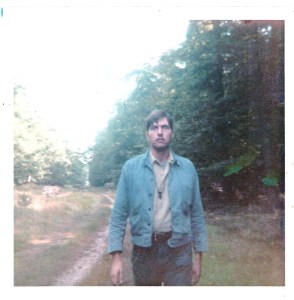
Me, in those gloriously sullen days
Me, in those gloriously sullen days

My friend Elaine Stirling, in collaboration with herself, has produced fraternal (sororal?) twins!

Tim C. Taylor's avatarGreyhart Press

It’s here! Our two new book launches are available in paperback from amazon.com and amazon.co.uk; in Kindle Stores worldwide and on Smashwords. It’s all part of a scheme to revitalize a form of poetry that entranced early Renaissance European courts… the glosa.

Further details are  on the web pages for the books: Dead Edit Redo: A novella of Horror and Good Medicine and Dead to Rights: A Circularity of Glosas.

Join in on Twitter: #bringingbacktheglosa

These books are amazing, but to explain in a sentence doesn’t do them justice. The best way to enjoy the books is to read both in succession (in any order; that’s the circularity for you). Here’s a taster from the press release…

Anglo-Canadian campaign launches to revitalize the poetry of the Troubadours

Canadian heteronymic professor publishes collection of ‘glosa’ poetry and stars in horror novella as part of the #bringingbacktheglosa campaign.

Bromham, Bedfordshire…

View original post 828 more words

Me, an egoist? Why yes!

Id est, ego impedirent.  It’s a pun:  (The id) is, (the ego) obstructs.  Wicked little thing, the ego, isn’t it?

Well, no.  According to Herr Doktor Freud, who made all this up, if it weren’t for the ego, we’d all be hellish little biennials in massive grown-up bodies.  Of course, some of us are just that, but it’s from a lack of ego, not a surfeit.  In any case, it’s a package deal, not sold separately.

It’s possible he was wrong.  It’s possible it’s not a package at all, but a great, shining orb, uncleavable and protean, take it all or leave it all, no quantum bits involved.  But we like to think he was right.  It feels right.  We want something, and the little voice inside the head schemes how to get it while not getting whacked for it. All the while some part of us debates if it’s worth it, all things and the gods of them considered.  It just feels separate, doesn’t it?  It’s id, ego, and superego, in that order.

The id just is, i. e, i. e.  It operates on the pleasure principle, which should be familiar to most of us.  Something inside doesn’t feel right.  Homeostasis not achieved.   Prepare to repair.  Want THAT!  Pure organic desire, switched on when something is lacking, and running until we get it.  It’s why we don’t get absorbed in cloud watching and forget to eat, or why we don’t keep sitting on a hot stove, while discussing that odd smell.  Survival is all for id, the original single-issue voter.  Unfortunately, things can get testy when other people are involved.

Enter the ego.  We are, after all, social animals.  We literally (yes, I literally mean literally) cannot survive without each other.  There are no known cases of genuinely feral humans; every wild child of lore at least began life in the bosom of family.  What we do after we’re grown is another issue; we’ve already created ourselves by then.  The ego mediates the demands of the id, and puts them in acceptable form to allow us to continue to live with people.  How tedious!  How antithetical to our extreme, no-limits values!

What oxymoronic rhetoric!  Remember, those are our values; we collectively decided that’s how we want to live.  Hidden in there is the implicit need to mitigate our effects on each other.  That’s what the ego is for, keeping that self absorbed, childish, hedonistic jerk, the id, on a leash.

That’s the superego keeping the ego on a leash.

Heilige Sigmund und seine Phalikensymbolle

Der Heilige Sigmund und seine Phallussymbol