Report 12a: Other interesting species

The dominant species on Planet X is, like us, exoskeletal in structure, with a strong centralized information/analytic core operating over numerous individual foraging operative units, again like our own configuration.  This should not be surprising, as all of our projections have strongly suggested that this is optimal for species to progress intellectually.  This species, or more accurately, array of species, in the native taxonomy, is designated Blatta or Blatella, colloquially cockroach.

However, there are several other life structures more or less successful on the planet, most of them part of the Blattoid survival system, but still of interest in their own right.  The closely associated Homo genus is particularly fascinating, as it has developed a kind of neuronal autonomy, all while fulfilling its primary function as Blattoid food aggregator.  This neatly illustrates the principal of progress within dominance driving progress among subordinates as well.  The benefits trickle down, as it were.

This group is a part of a large subgroup of life that has internalized skeletal structures, strange as it may seem that such an adaptation could survive the rigors of planetary change.  No doubt it was successful only due to its usefulness to the more abundant exoskeletal populations.  The internalization process appears to have been more general as well, since most species live outside the protective and nourishing saline water environment; they have evolved a means of carrying these essentials within them.  Not terribly efficient, one might argue, but there they are.  Indeed, the Blattoids themselves largely live outside water, as well.

Homo is a very homogeneous genus, having survived a major killing episode some 2,000 generations earlier as a single breeding population, or at most 2-3 such populations in close contact.  The only extant species is the sapiens sapiens variety, others having died out.  As a result of the extremely short breeding history since geographic expansion, they are a remarkably uniform species genetically, differing only by tenths of a percent.  Nevertheless, much appears to be made of such trivial differences as can be identified, perhaps as a mechanism to evolve to accommodate diverse Blattoid species;  more study is required, since this tendency is dysfunctional.

Perhaps the most curious attribute of Homo is the complete decentralization of species intelligence.  Instead, each individual carries its own ideational complex built upon a central nervous system; so specific is this center, that if the head, where it is located, is removed, the individual immediately shuts down, and is therefor incapable of fulfilling its role in the species from that instant.

The explanation, of course, of such an unlikely array of evolutionary elements is in the role of Homo in service to Blattoids.  Such extreme self-containment suddenly makes sense when seen as a response to the diverse situations in which roach populations find themselves; with primary food aggregators able to act spontaneously and autonomously to procure proper Blattoid habitats, any unforeseen problems can be easily averted.

The committee hopes  this study will be helpful in making full contact with the dominant intelligent species on planet X; it may well be simplest to proceed through the intermediation of their Homo servants, as unpalatable as that may seem.  Actually, though, they may be quite palatable, once their usefulness to us is ended.
Ringo, God, and art

Ringo Starr, it seems, got up in the middle of the night to feverishly write down the lyrics to “Back Off Boogaloo.”  He even attributed the inspiration to God.  It just goes to show you the bankruptcy of the whole idea of the artist interview.  It’s like interviewing an athlete following the big game.

“Tell us about that homer, Biff.”

“Well, you know, it was a hanging curve ball, and I saw it real good, and just took it the other way.”

Thanks, Biff.  That cleared up a lot of questions about baseball, and life itself.

It’s easy enough to understand that athletes might not be able to articulate exactly what was involved in a spectacular performance; they may not be aware of it themselves.  They might think it had to do with wearing their hats backwards, or eating only broccoli the night before.  It’s the classic distinction between knowing how and knowing what.  But you’d think it would be different with artists.  You’d think artists would start out with something specific in mind, make decisions about how best to convey whatever it was to their audience, and proceed according to some rational plan.  And they do.  Sort of.

“Tell us about that painting, Jackson.”

“Well, you know, the paint was real wet, and I saw the fan, and just spilled it over the canvas.”

That may be what we want to hear from Biff, but it won’t do from Jackson.  Why?

Because we think Jackson Pollock’s painting has some meaning, some value, beyond its physical self, even beyond its immediate context the way the homer does in the baseball game, even if that meaning is just a deeper realization that there is no deeper meaning (Oh, yeah, admit it, we do think like that).  Or at least we hope it has.  And so does the artist, and that’s the problem.  Because everybody’s invested in this idea that something not superficially apparent is going on with the painting/poem/song, we feel it needs explaining, in case some of us may have missed something, and who better than the person who created it.

Except the person who created it is not necessarily the best source.  The main reason for this is that great Freudian frontier, the subconscious mind.  Because of the way our silly brains work, what we’re trying to say is often not exactly what we think we’re trying to say; it could even be the polar opposite.  It’s the infamous Freudian slip, and art is its Baby Huey, the great bouncing 200 pound infant crashing through all the fine china we’ve so carefully laid out for the guests.  Ringo’s God turns out to be his own damn self after all, but not the self he’s used to playing with in public.

Unfortunately, it’s not much help when the artist being interviewed is a bit more self-aware.  Robbie Robertson , referring to writing The Weight, gives an excellent description of the subconscious process:

“I was just gathering images and names, and ideas and rhythms, and I was storing all of these things … in my mind somewhere. And when it was time to sit down and write songs, when I reached into the attic to see what I was gonna write about, that’s what was there.”

But what did the song actually mean?  Well, ahem, symbolic… blahh… Buñuel… surrealism.. that is, ahem..  Not sure, exactly.  It does mean something, but asking the artist isn’t much help, and in this case, at least, he’s up front about it.  At least he doesn’t insist it’s about a bender in Buzzard’s Butt, Arkansas, when everyone else is insisting it’s about the ultimate futility of human existence or something, or vice versa.  Not that it might not be both of those things, denials, affirmations, and ambiguities notwithstanding.  It’s all complicated, you see, by the fact that, once a work of art is released into the wild, it means anything anyone wants it to mean.  Ultimately, art is feral by nature, and there’s no getting around that.  Ask Frank Stella about St. Louis, Mo, and the Grand Pissoir.

Of course, there could very well be a real meaning, in the sense of something that motivated the work, whether that something was understood by the artist or not.  My own poetry is sometimes explained to me in ways I never imagined while making it, but which are entirely plausible to me on reflection.  It’s this ambiguity which is at the same time so enticing and so frustrating.  It’s not that there’s not a real meaning, it’s that there can be several real meanings, even contradictory ones.

If art were unambiguous, who would need it?  We already have sport.  Biff is never going to insist, “Homer?  That was a sac fly!  I hit the damn thing, and I don’t care how many idiots think it’s a homer!”

Dude.

In the 21st Century, everybody’s hip.  When everybody’s hip, you get all the arrogance without the artistic and intellectual excuses for it.

My great, great grandfather’s troika

Family stories beyond about two generations ought to be taken with a grain of salt.  But they ought to be taken, all the same, in the same way that myths must be taken.  There is a kind of truth in them, even with the embellishments required to fill in gaps.  This one concerns a great, great grandfather, a mild winter, and a wager.  A good combination, I should think.

It was, in fact, the mildest of winters in a part of the world where children’s tales involve ice maidens and ravening wolves, along with the occasional stark reminder that they’re not entirely fictional.  Snow comes early and often, and once the rivers and lakes freeze over they generally stay that way until the spring thaw.  Even today, in the deepest countryside, horse-drawn sleighs are not rare in winter time.  This particular winter the snows came late, and the air smelt of autumn into late November.  By the first couple of weeks of December, the waters had just begun to freeze, and a decent amount of snow had finally arrived, enough to change wagon wheels for runners in a land where roads were usually just a fond memory by this time.

My great, great grandfather, call him Jekab, lived out his life there, fortified against the deathly winters with buckets of vodka.  And the summers, come to that.  This was not a poor man, as these things go; he had a troika, a three-horse wagon, and any man who could use three horses just to get around was pretty well off.  Jekab even had his own little piece of land, a rarity in that time and place.  To be sure, he worked it himself, with help from the family.  You wouldn’t call him lord of the manor, but he was lord of the local tavern, for sure.  The long winters left farmers rather little to do beyond experimenting with various percentages of blood alcohol.  Jekab’s usual comrade in these endeavors was a sometime roustabout and usual layabout whom we shall call Gint.

This particular winter’s afternoon found Jekab and Gint sitting at their favorite seat at the tavern, overlooking the river.  Snow poured from the sky relentlessly.  The talk turned to a particularly alluring miller’s daughter, God bless and protect her, who happened to live at the mill just across the river.  As it happened, the ferry that crossed from just that point had finally shut down due to icing, and the nearest bridge was at least five kilometers away.  Snow already covered the icy river to a depth above the boot.  Still, Jekab expressed a desire to pay a visit to the lovely young lady, never mind his wife and children at home.  Gint, with his usual gift for claiming the obvious, scoffed.

“The snow’s up to your ass out there!”

“You’re the ass,” Jekab responded,”Knees, tops.”

“But you’ll fall on your ass after two steps, then where will the snow be?”  Both men roared with laughter at the thought of it, tears streaming down their faces.

Silence returned gradually.  Jekab looked straight into Gint’s rather bleary eyes.  “I’ll take the troika, you stupid shit.”

“You’d drive all the way to the bridge for her on a day like this?”  His eyes widened, truly impressed with such dedication.  But Jekab just waved away his words, as if they were no more than summer flies.

“Don’t be daft,”  he said.  “I’ll cross the river here.”

There ensued a lively debate about the thickness of the ice on the river, with Jekab insisting that if it could support all that snow, it could support a troika, and Gint pointing out that the weight of the troika would be added to the weight of the snow.  In the end, a wager was made.

The two men, along with a handful of the curious, stood in front of the tavern.  Jekab harnessed his horses to the troika and climbed aboard, turned it toward the river, and gave the reins a firm and resounding slap.  Off they went.

It must have been quite a sight.  Steam rising from the horses’ nostrils, the troika’s runners cutting through the mighty snow bank onto the river, Jekab swathed in fur, urging his horses into the blinding storm at the top of his lungs.  Then – silence.  They all disappeared.  All of them: horses, troika and great, great grandfather.  None of them was seen again until the spring sun melted the ice against the bridge down river.

Gint had won his bet, but lost his friend.  Life is like that.

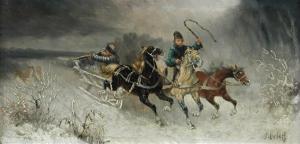
T. Orloff.  19th c. Russian

T. Orloff. 19th c. Russian