Faith alone

Recently, a blogger whose views I usually respect wrote a piece about Easter, lamenting that people just don’t believe in anything these days.  There were  lot of comments; mine was the only one that disagreed with the writer’s premise.  I’d like to go further, and examine the widely held notion that faith, in and of itself, is a great and wondrous thing, without which we would soon founder.

You hear this a lot, accompanied by a lot of sage nodding, amening, and otherwise approving responses.  Faith supposedly saves us from all manner of barbarism we would otherwise inflict on one another.  I don’t see any evidence for it, period.  It wasn’t 19 atheists who flew their hijacked airplanes into public buildings full of innocent people on September 11, 2001.  It wasn’t in the name of evolution that the Tsarnaev brothers blew up the Boston Marathon.  Down through history, you will find almost no atrocities perpetrated upon innocent victims by people who lacked faith, even the Nazi and Communist atrocities arguably fall in the category of faith despite lack of a supernatural power.  Where is there a single shred, the merest mote, of evidence that our hearts’ desire is to maim and persecute, and that we would cheerfully indulge ourselves were it not for faith?  I’ll grant you that we seem to torment each other with glee when it is to our perceived benefit, but belief in a higher cause only seems to confer a sanctity to it.  I’m reminded of Himmler’s famous admonition to the SS that while it may be emotionally difficult to slaughter Jews, one must grit one’s teeth and do it for the greater good of humanity.  He was only echoing Torquemada and all the other grand inquisitors since time immemorial.

And isn’t it more than a bit disingenuous to profess respect for all people of faith, when almost all religious faiths stipulate that those who believe differently will suffer an eternity of anguish?  Think about it.  You believe that if I have a different faith than yours,  after a few years of life on earth, I will suffer incomprehensible torment, not for a few millennia, but for all eternity.  Because you believe your God is perfectly just and merciful, you also believe I deserve every bit of it.  Yet you insist you respect me, and my faith.  Now that’s a Mystery!

Still, you might say, a person needs something to believe in, if not a religion, then at least a coherent set of principles.  That’s certainly an interesting assertion; it’s not clear what it actually means.  Will just anything do?  The ancient Assyrians believed their god Assur commanded them to conquer and humiliate as many people as possible as brutally as possible.  Very clear and consistent; their inscriptions brag about the heaps of flayed enemy youth left at the gates of conquered cities, and the rape and enslavement of the women and children.  Men of strong faith, all, not an atheist among them.

mesopo63

Victory stele of Naram-Sin

But wait, don’t faith and religion do a lot of good?  Yes, some do.  And some do a lot of evil.  Essentially, it’s a wash, so what’s the point of lamenting a lack of it?  The biggest irony of all, of course, is that far from suffering from a dearth of faith in these particular times, we seem to be positively deluged with it.  Religion is everywhere, and New Age faux religions seem to flow endlessly from an inexhaustible source.  Ideology has become a way of life even in this most pragmatic of nations.

A crisis of faith?  I’ll say.  We’re drowning in it.

Dear Dzhokhar

It was an awesome trip, wasn’t it?  Two big pops out of nowhere, smoke, fire, and chaos.  People screaming, blood everywhere, severed limbs, bits of unidentifiable flesh.  You and Tamerlan, the big brother you idolized, calmly receding from it all, going about your business, planning yet more chaos, unaffected by the drama, except to be swept off your feet by the sheer glory of it.

Was it more like Rambo or Grand Theft Auto?  Too cool.  Even when you were busted, the chase through ordinary streets, guns blazing, IEDs tossed casually from the window of your ride.  That must have shaken those pathetic American bastards right out of their La-Z-Boys.

You were two dangerous dudes, not to be messed with.

That was it, wasn’t it?  You just wanted to be dangerous.  None of this bullshit about Allah or Jihad.  That was for mom.  That just added a bit of mystery, some of that Middle Eastern spice.  You loved it!

You killed your own sweet beloved brother just so you could keep doing it a bit longer.

Yes, he was shot up.  Yes, he probably would have died right there anyway.  But awfully nice of you to slip that ride into gear, and drive right over him like he was just a piece of road kill.

Le Juif Errant

For the end of a week in remembrance of the Holocaust, I am offering up this post of mine from a couple of years ago.


the-wandering-jew-1925

Le Juif Errant, Chagall, 1925

When I was a boy, I developed an aversion to the art of Marc Chagall.  Why?  Because some of his work was used to illustrate a catechism we were tortured with in St. Philip Neri School.  I had no way of knowing at the time that St. Philip himself, a notorious iconoclast, would probably have flung the damned book out the window if we found it distracting.  After all, when one of his monks came rushing to him all aglow with the news that the Virgin Mary had visited with him while he prayed, he advised him to spit in her face the next time she disturbed his meditation.  Had I known, I might still be among the faithful, but there it is.

But I digress, as usual.  It’s what I do, isn’t it?  At any rate, as time went by, and the pain of extracting the religion from the boy, or vice versa (I’ll never know which), matured into a dull tingling sensation, I came to appreciate artistic trinkets like the Cathedral of Notre Dame and the Pietá without revisiting the centuries of pilloried self-worth it took to create them.  I came also to love Chagall, whose work I had so unreasonably imprisoned in the ghetto of my anti-religiousness.

I particularly came to love his 1925 painting Le Juif Errant, The Wandering Jew.  I saw myself in that character, his home bundled on his back, passing window lit houses with their cozy fires, on his way to his appointment with the Second Coming.  If you’re not familiar with the legend, it involves a Jew who berated Jesus on the way to the crucifixion for stopping to rest.  As punishment, he was condemned to wander homeless, and deathless, until the Jesus returned triumphantly.  Considering that early Christians thought that event was just around the corner, it must have seemed to them a curiously lenient punishment at the time!

Actually, the legend only came into full flower in the European Middle Ages, long after the alleged fact, so I suppose that’s irrelevant.  It dovetailed nicely with the social realities of Judaism in that time and place, Jews often being in commerce and other trades involving traveling, and culturally separate from the largely agrarian Christians.  Of course, these elements played a crucial role in antisemitism as well.  In a time when both the Catholic Church and Islam forbade money lending, and when capitalism was just being born, Jews were the only group religiously allowed to do the necessary midwifery.  Awkward, to say the least.

Anyway, it was this essential otherness that appealed to me.  I was born in a Displaced Persons (refugee) camp following WW II.  The land that would otherwise have been my homeland, Latvia, had been requisitioned in the name of the people by Stalin and his cronies, without much consultation with said people.  I had nowhere to call home.  My family eventually settled in the US, and now I’m as American as apple pie and, er,  sour cream, but I still harbor a feeling of not quite belonging, anywhere, really.  I’m not complaining.  The casual presumptuousness and giddy brutality with which social membership is often enforced more than offset the cozy warmth of it, in my view.  There’s a feeling of freedom, as well, in not holding yourself responsible for the original foundational sin of the prevailing system, whatever that may be.  The price, of course, is total responsibility for your own choices, but that’s a fair bargain.

Latvia, the sweet, imaginary homeland of my youthful dreams, never existed, of course.  In its brief experiment with independence between the World Wars, there was a tendency to authoritarianism, especially toward the end.  We’ll never know how that would have ended, thanks to Uncle Joe. Then there was the shameful massacre of the Jews at Salaspils and other places while the country was in the grip of  German Nazis.  Some, perhaps even many, Latvians, like the Vichy French, enthusiastically participated.

But things were not always thus.  A couple of years ago, I was wandering through what used to be the Jewish ghetto in Riga, now a sort of Russian quarter near the city market.  The ghetto was “cleaned out” toward the end of 1941, all the occupants trundled off to a nearby forest, and exterminated like so many cockroaches.  Turning a corner, I came upon a construction fence, and, sitting at a makeshift booth at the entrance, a young man with a bushy beard and a yarmulke.  It was the site of a new Latvian Holocaust Museum.  There were the expected photographs of Nazi atrocities, of course, but also the less expected evidence of mistreatment under the hands of the Soviets, who so often seem curiously off limits when discussing such things.  But what moved me the most were the stories and photographs of Latvia before the Nazis, before the Soviets, a country where Jews fleeing the progroms of czarist Russia could find a home.  Every major city in the country had a strong, proud Jewish heritage; Riga had one of the great yeshivas of Eastern Europe.  There was antisemitism, yes, but not as strong and not as institutionalized as elsewhere.  The nostalgic pictures of Jews during the inter-war independence years were especially moving, considering how all that came so cruelly to an end.

The Jewish population of Latvia was all but wiped out.  Even now, all these years later, it is still struggling to regain a footing.  As I see it, it’s a big chunk of my own cultural heritage, Jew or gentile, that’s been torn savagely off.  It’s genuinely heartbreaking.

Well, I’m not a Jew, so I guess I can’t be a Wandering Jew, my romantic imagery notwithstanding.  But we can travel together for a while and keep each other company.

Dude.

In the 21st Century, everybody’s hip.  When everybody’s hip, you get all the arrogance without the artistic and intellectual excuses for it.

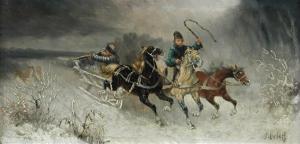
My great, great grandfather’s troika

Family stories beyond about two generations ought to be taken with a grain of salt.  But they ought to be taken, all the same, in the same way that myths must be taken.  There is a kind of truth in them, even with the embellishments required to fill in gaps.  This one concerns a great, great grandfather, a mild winter, and a wager.  A good combination, I should think.

It was, in fact, the mildest of winters in a part of the world where children’s tales involve ice maidens and ravening wolves, along with the occasional stark reminder that they’re not entirely fictional.  Snow comes early and often, and once the rivers and lakes freeze over they generally stay that way until the spring thaw.  Even today, in the deepest countryside, horse-drawn sleighs are not rare in winter time.  This particular winter the snows came late, and the air smelt of autumn into late November.  By the first couple of weeks of December, the waters had just begun to freeze, and a decent amount of snow had finally arrived, enough to change wagon wheels for runners in a land where roads were usually just a fond memory by this time.

My great, great grandfather, call him Jekab, lived out his life there, fortified against the deathly winters with buckets of vodka.  And the summers, come to that.  This was not a poor man, as these things go; he had a troika, a three-horse wagon, and any man who could use three horses just to get around was pretty well off.  Jekab even had his own little piece of land, a rarity in that time and place.  To be sure, he worked it himself, with help from the family.  You wouldn’t call him lord of the manor, but he was lord of the local tavern, for sure.  The long winters left farmers rather little to do beyond experimenting with various percentages of blood alcohol.  Jekab’s usual comrade in these endeavors was a sometime roustabout and usual layabout whom we shall call Gint.

This particular winter’s afternoon found Jekab and Gint sitting at their favorite seat at the tavern, overlooking the river.  Snow poured from the sky relentlessly.  The talk turned to a particularly alluring miller’s daughter, God bless and protect her, who happened to live at the mill just across the river.  As it happened, the ferry that crossed from just that point had finally shut down due to icing, and the nearest bridge was at least five kilometers away.  Snow already covered the icy river to a depth above the boot.  Still, Jekab expressed a desire to pay a visit to the lovely young lady, never mind his wife and children at home.  Gint, with his usual gift for claiming the obvious, scoffed.

“The snow’s up to your ass out there!”

“You’re the ass,” Jekab responded,”Knees, tops.”

“But you’ll fall on your ass after two steps, then where will the snow be?”  Both men roared with laughter at the thought of it, tears streaming down their faces.

Silence returned gradually.  Jekab looked straight into Gint’s rather bleary eyes.  “I’ll take the troika, you stupid shit.”

“You’d drive all the way to the bridge for her on a day like this?”  His eyes widened, truly impressed with such dedication.  But Jekab just waved away his words, as if they were no more than summer flies.

“Don’t be daft,”  he said.  “I’ll cross the river here.”

There ensued a lively debate about the thickness of the ice on the river, with Jekab insisting that if it could support all that snow, it could support a troika, and Gint pointing out that the weight of the troika would be added to the weight of the snow.  In the end, a wager was made.

The two men, along with a handful of the curious, stood in front of the tavern.  Jekab harnessed his horses to the troika and climbed aboard, turned it toward the river, and gave the reins a firm and resounding slap.  Off they went.

It must have been quite a sight.  Steam rising from the horses’ nostrils, the troika’s runners cutting through the mighty snow bank onto the river, Jekab swathed in fur, urging his horses into the blinding storm at the top of his lungs.  Then – silence.  They all disappeared.  All of them: horses, troika and great, great grandfather.  None of them was seen again until the spring sun melted the ice against the bridge down river.

Gint had won his bet, but lost his friend.  Life is like that.

T. Orloff.  19th c. Russian

T. Orloff. 19th c. Russian