Government loyalty

We live in fascinating times.  We are outraged by government incursions into our corner of the Grand Database, while at the same time we cheerfully surrender any and all information about ourselves for a 10% discount at Best Buy.  In fact, we seem to be outraged by almost anything the government does these days, up to and including holding public trials to determine someone’s guilt or innocence, which we now seem to be convinced are contrived and predetermined whenever they fail to conform to our own conclusions.  These conclusions, of course, are based on what information we could glean from the news media, which we firmly believe are utterly untrustworthy, with notable exceptions, which I’ll discuss momentarily..

How has it come about that we offer up the most bizarrely intimate details of our lives daily on Facebook, yet man the barricades when it transpires that some government agency might have been reading them?  Or cough up our phone numbers and email addresses on demand when checking out at Home Depot for no apparent reason?

Well of course, you say, no point in getting a loyalty card, and then clamming up about it, is there?  There’s a sacred bond involved, similar to the bond that ties us to certain news outlets, those we are sworn to believe regardless of the absurdity of their dispatches.  Therein lies a glimmer of hope for resolving this crisis of confidence.

Government loyalty cards.  Get a loyalty card, and get a discount when you present it at tax time.  Pay more taxes, get a bigger discount.  We’d even get special offers in the mail, both snail and e, for holiday sales tax rebates, or jury duty aboard a luxury cruise ship, half price if you volunteer immediately.  All of this can be easily paid for by adjusting the “normal” tax rates for those who don’t have loyalty cards.

We might believe everything the government tells us, as we do with Fox News or The Guardian, if we thought of them as our tribe.  We might even believe government policies are based on the moral code of humanitarianism.

Correspondence from the dawn of time

Archaeologists have uncovered a stone slab with what appears to be the earliest correspondence ever.  The hypothesis is that the slab was exchanged with each new entry.  Here is a transcript.

Not the slab, but stone like it.

Not the slab, but stone like it.

Hi

Why do you give me this?

No reason.  Just Hi.

What you want?

Nothing, just friend.  What wrong with that?

Here a small circle has been carved, with a curved line in the lower half, and two dots in the upper.

What this shit?

It’s like face, smiling.

OK, haha.

BTW, I have plenty hides, for you, cheap.

Here are just random chips, odd symbols, in a pattern suggesting anger.  There appears to be the figure of a man, decapitated.  The rest of the slab is blank.

____________________________________________________________________
Photo credit: http://www.newsgd.com/travel/routeofthemonth/200606080058_60340.jpg

The stamp man’s complaint

Janos was a good and dutiful man. He had a small house with a neat little garden plot overlooking the railway station.  He kept his petite wife well supplied with money for groceries, flowers, and other necessities.  And every morning without fail, he boarded the 7:10 into the center of the city, to report for work at the Bureau for Auxilliary Affairs, precisely at 8:00 AM.  His record was unblemished, save for the time he choked on a digestive biscuit and had to be taken to the clinic for treatment. He was 2 hours late that morning; it is possibly the reason he was passed over for promotion yet again.

Which is a damn shame, really. His job was to approve paperwork as it passed through his station. He was a stamp man, and possibly the best in his section, the Department of Supplemental Approval. The official rate of passage of forms to be approved through his station was 30/hr; he himself estimated it at more than 100. Theeoretically, he could mark any given paper with the bright red Returned fo Further Evaluation stamp, rather than the bright green A, but that slowed things down considerably, as he would have to fill out the proper form, and hand carry it along with the Returned paper down the hall to the Department of Approval Appeals. Janos considered this a waste of valuable time, as there was no one ever there. One dropped the papers ino a slot marked IN, and they disappeared. Meanwhile, paper at one’s own station was piling up relentlessly. Over the years, he had gradually come to simply approve everything that came through. That had been an immense relief, for it meant he no longer had to read the papers as they came through; indeed, truth be told, he had forgotten the criteria for approval, or even the nature of the forms themselves. Perhaps that accounted for his legendary efficiency. Janos’ days passed smoothly and inevitably. He was happy, and his superiors were happy. Though not so happy as to promote him.

And so, in the course of events, came this particular day, which to all appearances differed not one whit from any other day.  It was also a day Janos would regret for the rest of his life.  For it was the day he glaanced down at a form before stamping it.  He read,

milk
bread
1 ib butter (unsalted)
tea (Elina’s favorite)

It was, truthfully, not what he expected. True, he was no longer sure what the paperwork was about, but this seemed unlikely. With a hint of a tremor, he reached over to the top of the pile to his left, the already approved pile, and nervously looked at the top, most recently approved paper.

Dearest Sylvia,
I can no longer be responsible for the fire in my heart. I dream constantly of your warm white breasts, the razor-like nipples piercing…

He had read enough. A cold hand gripped his heart. It must have been a quarter hour before he slowly returned his attention to the pile. With each paper, each word, his heart sank further into his shoes.

Draft dodging revisited

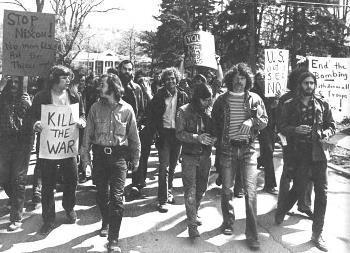
Let’s get one thing straight at the outset: Saving your own ass is a perfectly honorable reason to avoid military service, if you don’t see a compelling reason to go to war in the first place.
au-war-protest-w

And another thing:  those were crazy times, the 60s.

The beats, those semi-feral gnosticati whom we came to later venerate, were creatures of the WW II aftermath, in exactly the same way as the Lost Generation was of WW I.  An incomprehensibly brutal war had beaten the bejeezus out of the population at large, and those few sensitive and creative souls who could banded together in resistance to the Great Blanding that followed.  They were artists, primarily, painters, poets, musicians, above all uncynical and undisillusioned, still willing to bite on the bare hook, still enthralled by beauty and the ideal.  Do I surprise you?  That cynical, hip beatnik pose that’s so familiar was a disguise at most, at worst a caricature painted by a society that wanted nothing remotely experimental to happen for the foreseeable future.  The war and the depression it followed had been adventure enough, thanks.

But, for better or worse, the beats became famous, especially for naturally rebellious young folk, always feeling stifled, but particularly in that post-war treacle of the 1950s.  For them, Kerouac, Ginsburg, Ferlinghetti, and the rest represented not only freedom from accountability, but an expression of creativity completely unfettered by the constraints of the responsible, normal, world.  Never mind that Kerouac actually lived with (not to say on) his mother in Lowell between cross-country adventures, or that Ferlinghetti had served honorably in the Navy during the war.  Come to that, never mind that most of the people who so earnestly emulated them were safely enrolled in college.  It was a ramblin’ kinda thing by the early 1960s, a confusion of Woody Guthrie and William Burroughs, sort of a gay, jazzed up Alan Lomax thing, a place where Coltrane and Leadbelly were equally likely to be heard on the hi-fi in any given off-campus apartment.  And, thanks largely to sheer romance, it was all vaguely leftist.  Posters of Rosa Luxembourg, or someone equally suitably obscure, were everywhere.  People carried anarchist paperbacks in their hip pockets.  It never occurred to most to read the damn things.  Best of all, it was cozily small, an invitation-only subterranean elite.

I say this stuff as a member of that wannabe tribe, or, more accurately, as a wannabe member of it; my own background was far too odd for easy acceptance in what amounted to a splinter group of the middle class.  I was born a refugee, a natural intellectual, an ex-Catholic who grew up in a not-so-pretty working class neighborhood, in which the inhabitants would never have dreamed of calling themselves working class, or any other class for that matter.  In my neighborhood, graduation from reform school was as typical as graduation from high school, and of roughly equal status.  Almost nobody outside my immediate family went on to college.  Such was my enculturation; I didn’t have the savoir faire for acceptance as a middle class rebel.  Worse yet, as an exile from Latvia, I had no great affection for Marxist pipe dreams.  But enough disclosure.

In the midst of this happily angst-ridden fairyland, the war in Vietnam came gnawing like a small but determined troupe of mice in the pantry.  Begun by Eisenhower as a way to shore up Indochina after the expulsion of the French, it might have remained an obscure haven for covert operations, but for a series of circumstances, too complex to go into here, that led Lyndon Johnson to try to win it and get out quickly.  That meant escalation, and that meant that the draft, which during much of the late 1950s and early 1960s had been little more than a minor nuisance, became a jarring reality to the pleasant little community of rebellious savants, many of whom were in and out of college as if it were a game of musical chairs.  This was a real problem when it came to student draft deferments.  In those early days, if you lost your 2S status, you were next.  What to do?

Why, protest, of course.  At first, it was uncomfortably small groups carrying signs, in emulation of the Ban-the-Bomb rallies a decade earlier.  Intellectuals, who had studied the background to the war and had an understanding of the stakes, and of its place in leftist dogma.  Later, as more and more young men in college realized they could very well end up in the Army if nothing changed, the ranks were far less well informed, but considerably more sanguine.  I don’t impugn the integrity of each and every war protester of the era; there were certainly many who were sincere in their beliefs.  But many more simply wanted to avoid a dangerous detour in their well ordered lives, and still others saw a way to exploit a growing movement for their own ends.  Suffice it to say that the implications of the “Girls-say-yes-to-Boys-who-say-no” campaigns of the late 1960s were not lost on the many young men of the day.

Of course, people could have simply admitted that they saw no good reason for the war, and thus wanted to save their own asses.  After all, saving their asses was what the young men who did go to war were doing every day; nothing dishonorable about it.  Even those few who didn’t end up in Vietnam just by default of the system, and who really went on an idealistic mission to stop communism, in the end only fought to save their own asses, and those of their comrades.  Honesty, as usual, though the best policy, was the least popular.

As a result of all this duplicity, it became a Matter of Principle, which is to say that people chose up sides and bitterly denounced those who refused to join them.  It is a testament to this fundamental lack of good faith that to this day there remains a considerable amount of rancor in the remnants of the debate.

And me?  I got drafted, and ended up joining the Air Force, serving in Okinawa and Germany, ironically skirting Vietnam altogether.  I didn’t join because I believed in the war, or because I was afraid of the criminal consequences of dodging the draft.  I joined so as not to break my father’s heart.

That’s about all the honor I had in me; it still is.

_____________________________________________________

Photo credit: http://www.alfred.edu/pressreleases/viewrelease.cfm?ID=7252

Report 12a: Other interesting species

The dominant species on Planet X is, like us, exoskeletal in structure, with a strong centralized information/analytic core operating over numerous individual foraging operative units, again like our own configuration.  This should not be surprising, as all of our projections have strongly suggested that this is optimal for species to progress intellectually.  This species, or more accurately, array of species, in the native taxonomy, is designated Blatta or Blatella, colloquially cockroach.

However, there are several other life structures more or less successful on the planet, most of them part of the Blattoid survival system, but still of interest in their own right.  The closely associated Homo genus is particularly fascinating, as it has developed a kind of neuronal autonomy, all while fulfilling its primary function as Blattoid food aggregator.  This neatly illustrates the principal of progress within dominance driving progress among subordinates as well.  The benefits trickle down, as it were.

This group is a part of a large subgroup of life that has internalized skeletal structures, strange as it may seem that such an adaptation could survive the rigors of planetary change.  No doubt it was successful only due to its usefulness to the more abundant exoskeletal populations.  The internalization process appears to have been more general as well, since most species live outside the protective and nourishing saline water environment; they have evolved a means of carrying these essentials within them.  Not terribly efficient, one might argue, but there they are.  Indeed, the Blattoids themselves largely live outside water, as well.

Homo is a very homogeneous genus, having survived a major killing episode some 2,000 generations earlier as a single breeding population, or at most 2-3 such populations in close contact.  The only extant species is the sapiens sapiens variety, others having died out.  As a result of the extremely short breeding history since geographic expansion, they are a remarkably uniform species genetically, differing only by tenths of a percent.  Nevertheless, much appears to be made of such trivial differences as can be identified, perhaps as a mechanism to evolve to accommodate diverse Blattoid species;  more study is required, since this tendency is dysfunctional.

Perhaps the most curious attribute of Homo is the complete decentralization of species intelligence.  Instead, each individual carries its own ideational complex built upon a central nervous system; so specific is this center, that if the head, where it is located, is removed, the individual immediately shuts down, and is therefor incapable of fulfilling its role in the species from that instant.

The explanation, of course, of such an unlikely array of evolutionary elements is in the role of Homo in service to Blattoids.  Such extreme self-containment suddenly makes sense when seen as a response to the diverse situations in which roach populations find themselves; with primary food aggregators able to act spontaneously and autonomously to procure proper Blattoid habitats, any unforeseen problems can be easily averted.

The committee hopes  this study will be helpful in making full contact with the dominant intelligent species on planet X; it may well be simplest to proceed through the intermediation of their Homo servants, as unpalatable as that may seem.  Actually, though, they may be quite palatable, once their usefulness to us is ended.