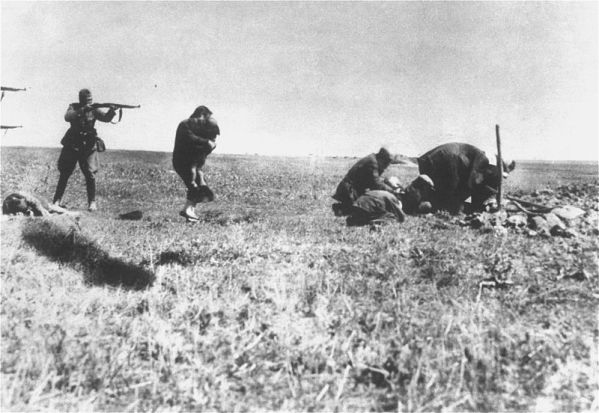
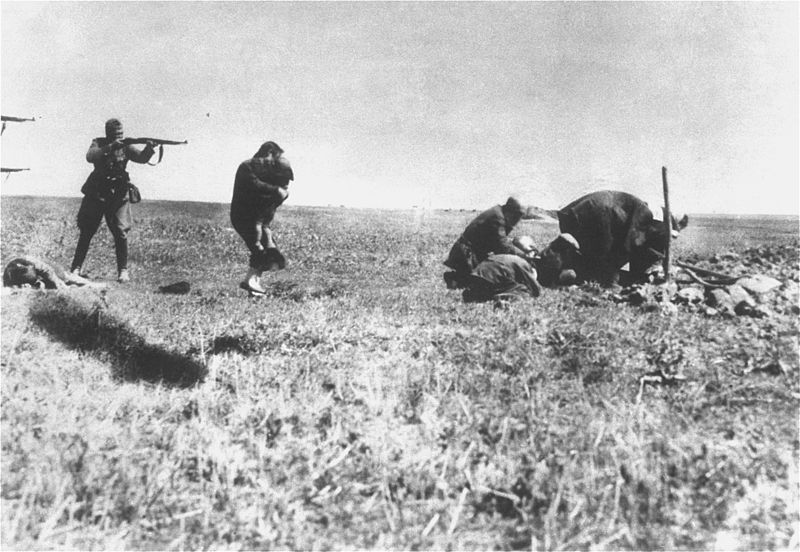
Jews being executed at Ivangorod. Source: Wilkimedia commons
I see a lot of gloom in the public literature lately, the idea that we have come upon horrible and chaotic times, the like of which have not been seen in recent history. Certainly, some concern, even alarm, is justified, especially where global climate change is concerned, and I wouldn’t hesitate to acknowledge the seriousness of various international crises, especially those in the Middle East, but let’s step back a bit and take a deep breath. How is humanity really doing these days?
Look, I’m no Pollyanna. We’re not in Utopia, folks, I understand that. And I fully understand the literary bias towards the dismal. Doom looks more serious than optimism, pessimism is often mistaken for clear-eyed realism, and both are so attractive to writers facing a blank page that it’s no wonder how often they succumb. I even approve of the role of writers as coalmine canaries, carriers of unpleasant but necessary information for the welfare of the society. What I do object to is the increasing surrender to despair and bitterness (ahem, poets). This abjectness is understandable for the victims of the various disasters occurring around the world. It is inexcusable from people who, consciously or unconsciously, present their work as a sober reflections on reality.
Compared to the 20th century, the 21st, so far, is a cakewalk. Are there wars springing up everywhere? Not anything like World War I, in which 18 million lives were lost. Soak that up. 18 Million. But that was a drop in the bucket compared to World War II. Estimates of fatalities in that war range from 60-85 million, about two thirds of which were civilians. In addition to the roughly 6 million Jews that were fried in Nazi ovens, at least that many non-Jews were also executed: Roma, homosexuals, socialists, Catholic clergy, even persons whose great crime was that they were handicapped. Not just in the line of fire. All these people were systematically rounded up and executed, like so many floor sweepings. Humans. Mothers, fathers, brothers and sisters. I often hear people sigh and wonder at the apparent inability of Africans and Arabs to live in peace. They’re amateurs, compared to Europeans.
Let’s not forget the two major revolutions in the last century: Russia and China. In the Soviet Union, it is estimated that more than half of the 20-30 million casualties attributed to World War II can be tied to purges and forced mass migrations instigated by Stalin to rid himself of elements he considered disloyal. The modern troubles in Chechnya and other hotspots in the Russian Federation can be traced directly to this. Huge masses of native Chechens were moved out, and ethnic Russians moved in to replace them. The gulags were full to bursting, in unspeakable conditions: sawed-off oil drums as indoor latrines, little or no heating. Often, inmates would waken in the Siberian morning with their hair frozen to the wooden pallets they slept on.
Let’s not forget diseases. Horrible as the AIDS virus is, it’s not anywhere near as deadly as the 1918 flu epidemic, which infected about 500 million people worldwide, and killed as many as 100 million of them, almost 5% of the world population. This came on the heels of World War I, whose charms I discussed above.
I could go on. China’s revolution held its own horrors, including the Red Guard madness of the 1960s. I won’t even start on the psychological damage attributable to the Cold War, and its policies of Mutual Assured Destruction, an apt acronym if ever there was one.
So why all the doom and gloom now? Maybe it’s the instant and constant access to the global if-it-bleeds-it-leads news media. Maybe, in the case of the US, where we seem convinced that not only is the world coming apart at the seams, but all our politicians are either evil, crazy, or both, we’ve grown so used to comfort that our greatest fear is losing some, even any, of it.

 Omniop