Peasants

No one understands the peasant.  Not the lords in their manor houses, not the bloody saviors of the masses, not all the bishops in hell.  Whether they think we need saving, scourging, stamping out, breeding, baptizing, arming, disarming, manipulating, controlling, or just crushing underfoot, none of them understands one simple truth: after they’ve burned and pillaged each others’ castles and cathedrals to the walls of Armageddon, we’ll still be here, not much the worse for the wear.  It’s what Jesus meant about the meek inheriting the Earth.  He wasn’t pontificating, just stating a simple fact.

Peasants belong to the Earth.  She is our mother, not in some New Age, crystal gawking way, but as an ordinary truth.  We’re more feral than not.  We sprang from the soil like autochthons; in the great divine arc of history, our job was to provide pillage.

We tend to be naive, and easily duped.  It’s not something that can be educated out of us.  It’s a genetic propensity to take others at face value, and we’re stuck with it.  You might argue that this is a fatal flaw, yet here we are, aren’t we, while all the bloody Ulyanovs, Romanovs, and Cromwells have long since mouldered away clutching their cleverness to their poisonous hearts.  We hate and fear, but never despise.  We love too easily.  It’s our greatest weakness.  It kills us every time.  It’s what saves us every time.

Religion tends to fall lightly on our shoulders; we’re not built for worship when  reverence will do.  We have churches, but woodlands and moors are more sacred to us than pews.  On those rare occasions when religion settles into a peasant’s heart, it is an ugly thing.  Rasputin, sure, but Stalin and Mao had the disease just as surely, albeit behind a mask of social theory.  Peasants tend to overdo power in general.  It’s just like us, isn’t it?  Rubes, at heart, in loud suits.

My homeland, Latvia, is as pure a peasantry as you’ll find anywhere.  The culture, the very language, exists only because the lords and saviors who plagued us over the centuries didn’t think it worth extinguishing.  Typically, when Latvia gets praise, as it recently did from the IMF for being a model of the kind of austerity Europe needs to pull out of the recession, it’s for taking its flogging well, without causing trouble.  All the more disheartening, then, to learn that the flogging was not only unnecessary, but only made things worse after all: the theory behind all the demands for economic austerity has just been shown to be based on flawed data.

Suckered again.

Maxed

Perhaps you’ve wished you could overclock your brain, squeak out the maximum possible speed along those neuronal freeways, move over to the no-exits-till-destination through lane and push the pedal to the metal.  Maybe pigs have wished for wings.  Maybe you’ve wondered what the hell you should wish for, anyway.  Maybe you’ve heard of Kydippe, the ancient priestess of Hera, who was late for a big festival five miles away with no oxen to pull her wagon.  Her two wonderful sons, Kleobis and Biton, pulled her in that wagon the whole way, had a great time at the festival, then fell asleep, exhausted but happy.   She was so grateful to have such wonderful sons, she asked Hera to give them whatever the goddess deemed the greatest gift a mortal could get from a deity.  Hard to go wrong there; get the gift and the divine opinion in one package.  If wishes were knishes…

But this isn’t so much about wishes as it is about supercharged brains.  I mean, the blathersphere is awash with stuff about how we only use some pathetic little percentage of our brains, and wouldn’t it be grand if we could use the whole calabash.  Why, we’d be geniuses!  No end to what we could accomplish.  Assuming, of course, we wouldn’t just use them to make up more ways to distract ourselves while driving.

As it happens, I might have some insight into that very question.  Not uniquely, perhaps, but I’m willing to write about it in a way that doesn’t involve statistics.  You can thank me later.

I have had migraines for about fifty years.  Not constantly, of course; I’d be even wackier than I am now if that were the case.  Don’t ever let anybody, M.D., D.C, Ph.D., or any other alphabetical combination, tell you they know what causes migraines.  In fact, that would be a good reason to immediately strike them from your list and move on. Nowadays, with new imaging technology, they’re just beginning to piece together the beginnings of an understanding, but there’s a long way to go.  There could very well be a number of very different causes.

The medication regimes over the years have been wonderfully zany, running the gamut from just sucking it up (because mostly women had them, so they must have been imaginary) to positively psychedelic.  Cafergot, an early fave, was a combination of caffeine and ergotamine, which you may have heard of in reference to St. Anthony’s Fire.  The basic divide has been between stuff you took when you got a migraine, and stuff you took to keep from getting one in the first place.

I went with Plan B, because my migraines became so frequent and severe, I was having trouble holding down a job as a bum.  My choice, a good one at the time, was propranolol, a beta blocker, which works quite well for keeping migraines at bay, or at least reducing their frequency and severity to the point where they’re just a nuisance.  Problem is, it makes you depressed, so I also began paroxetene, an SSRI, for that.  Two very powerful psychotropic drugs, dudes and dudesses, but they worked, for something like fifteen years.

Until they didn’t.  That’s the fascinating thing about migraines.  We know everything about them, except what we need to know in any particular case.  For whatever the reason, the migraines started coming back about a year and a half ago.  Yes, yes, that’s when I stopped teaching.  Do not even think of going there.  Anyway, I got a fancy new specialist doc, dumped the old pills, got a fancy new one, topirimate; then the fun began.  Perhaps you’ve heard of Pecos Bill, the cowboy who lassoed a tornado?

This was the drill:  The first week I’d cut the old pill dosages in half, and start with a half dose of the new stuff.  Okay then, off we went.  A bit of a buzz, but not bad, all things considered.  Dropping propranolol  was no worry, but I had heard all the horror stories about ditching paroxetene.  In truth, 80% of people who stop it have no problem (Okay, I promised no stats, but, come on, that’s such a little one!).  The other 20%, however, do have withdrawal problems, some quite severe.  By far the most frequent severe withdrawal symptom is a return to the original problem for which the stuff was prescribed, but in spades.  That’s bad, because it’s most often prescribed for major depression, which unfortunately is still often confused with feeling blue because, say, your budgie doesn’t seem to like you anymore.  In my case, it was to counter a side effect of propranolol, which I was also stopping, so I wasn’t very worried.

The whole SSRI thing has, however, become an Issue, if you take my meaning.  Not long ago, when I dared to meekly suggest on a Facebook thread that perhaps SSRIs might possibly have some miniscule, almost infinitesimally microscopic positive effect, I was administered an extended and vicious tongue-lashing, laid on with a will, that left me virtually bleeding for hours.  Or maybe it was a byte-lashing, since it was online.  Anyway, online search engines are so dominated by anti-pharma advocacy groups and the pharmacological industry itself that it is virtually impossible to find any seriously useful information on the subject.  Which is a damn shame, because it is sorely needed.

“Yeah, yeah,” you’re saying. “I thought this was going to be about super brains and what-not.  Get on with it.”  Sheesh!  People are so impatient.

Alright, then, week two!  Out with the old, double the new!  (Attention, songwriters).  That was the plan, actually, for good; there wasn’t a week three plan except to keep on.  The first couple of days were super buzzy, kind of like the 70s, except I never liked uppers very much.  Now I like them even less.  My mind was racing, going in every conceivable direction at once, and one or two inconceivable directions.  Ideas for new essays were queued up in twos and threes.  Poetic images were pushing each other out of the way faster than a spinning movie montage.  I remember one incident  where I was frantically looking for a pen and some paper to write down an idea, when I had to stop to scribble down another idea on a … what?  You might think this is a writer’s dream.  It was.  A nightmare.  Perhaps you recall when Lucy and Ethel had the job in the chocolate factory?  I was brusque and impatient.  Somebody unfriended me on Facebook, although she did take the time to do it very nicely through an explanatory message.  That right there should have sent up a red flag; unfriending is supposed to be an altogether hostile affair.

Topirimate works kind of like liquid plumber for the brain.  Gone are all the clogs.  Open all the sluice gates and let the neurons roll.  Your brain is now bored and stroked, your head chopped and channeled.  Your metaphors rebelliously mixed.  This is why it works for migraines, because it keeps things clear of piled up electrical bits, which, when released, cause those cerebral thunderstorms.  Don’t mess with me, I’ve got a poetic license.

All the same, I am at a loss for a word to describe the feeling.  I felt taken apart.  I wasn’t sure where my boundaries were, where my body stopped, how it fit together.  I had become a cubist painting.  One harrowing night, I awoke feeling that my body, all of it, my head, my feet, hands, was no longer large enough to contain me, in the same way a garment might be suffocatingly tight.  There’s no word for that feeling, not fear, or panic.  It’s a thing unto itself.  It ended, not clear how.   Memories of illicit drugs, decades ago?  Years of exploring various arcane relaxation methods?  Mindfulness?  I slept a bit after that.  I dreamed the screws holding the sheet metal panels to me had gotten loose, and I had to go around and tighten them.

The next morning I knew something had to be done.  I dreaded sleep.  When you dread sleep, folks, it’s all over.  I halved the topirimate dosage, back to what it was before things came apart, and called my neurologist.  It was my amazing good fortune that he had had a cancellation that very day.  He confirmed my decision to cut the dosage back;  as they say, your mileage may vary, and I’m apparently very sensitive to this drug.  I’m still on it, still off the propranolol and the paroxetene, and migraine free.  All’s well that ends well.

You might be expecting an anti Big Pharma rant at this point.  Sorry.  My mother suffered from migraines all of her life.  So did I, from the age of fourteen until I started on propranolol.  If you think migraine is just a headache, and people should just stop whining about it, there’s no point in trying to squeeze information past that; I won’t bother.  All these drugs are powerful, they all have side effects.  Is Big Pharma evil?  Don’t be silly.  The SS was evil.  The NKVD was evil.  You start calling things evil, and you have lost your freedom of action; the only rational option you have left yourself is the complete destruction of the Spawn.    Are the Drug companies just trying to make money?  Do you work for free?  There needs to be an overhaul of the regulatory system, that is true.  But if you think you’re safe because you rely on the just-as-money-grubbing, totally unregulated organic supplement industry, I have only one question:  How’d that bridge thing work out?  Just as an aside, because something grows in the woods doesn’t mean it has no side effects or interactions with other nice plants.  That’s how all those medicine men down through the ages kept their jobs, with a lifetime of training.  You can’t duplicate that with a couple of books and a chat with a supplement salesman.

And oh, yeah, if you didn’t already know or haven’t guessed, Hera did give Kleobis and Biton the greatest thing a goddess could give a mortal.  She killed them on the spot, in their happy and contented sleep.

I lied.  This was about wishing after all.

rivera_cubist_jportrait

How to be a critic – or not

When I write, I occasionally think in terms of mechanics like structure.  Generally, though, I’m sort of a gut writer, meaning that an idea pops into my head from god knows where, and I sit down and start writing.  I write until I can’t.  Then I mope about until more ideas from the ether inject themselves.  I write some more, stop some more, and so it goes until the thing resolves itself.  Those of you who have read my posts on this blog are probably not terribly surprised at this revelation.

I do revise, of course, and over the years of reading and writing I’ve internalized the rules of style and structure to the point where they function at the same level as the rules of grammar.  This is a nice way to operate, as it leaves me free to flit about like a butterfly and not think about rules until I’m ready to break them.  Which, come to think of it, is rather a lot, like right now.  On the other hand, thinking about them tends to send me off on a tangent, like right now. I have a friend who delights in finding obscure, forgotten poetry and reviving it.  This usually involves precise meter and line counts, cryptic messages, and rhyme schemes that blow right through the alphabet.  She whips up these delectable tiered confections as easily as if they were Aunt Jemima’s Buttermilk Pancakes, with absolutely no apparent sacrifice of spontaneity or evocative power.  I love what she does, but I’m afraid I’m better at granola, myself.

Anyway, I’m telling you about my writing habit to explain why I’m a lousy critic:  because the art of criticism involves re-externalizing all that stuff I’ve spent a lifetime internalizing.  Worse yet, it makes you read through all that scaffolding out where you can see it.  From a lit-crit point of view, I’m a terrible reader.  I take characters at face value.  I don’t care what Achilles symbolizes, he’s a jerk.  In short, I cheerfully fall for all the author’s tricks and traps.  I squirm and get crabby when people start talking about the true meanings of things in literature.  I want that stuff to soak in slowly, naturally, the way a gentle rain permeates the soil after a dry spell.  If I fancied a swill I’d get Cliff’s Notes.

I used to have an on-going argument with a friend, no longer with us, whose specialty was lengthy exposition of all the bits and pieces and hidden meanings of films.  Our disagreement concerned jokes.  I maintained that while you could get some pleasure from a joke that had to be explained to you, it could never match the pleasure of “getting” it spontaneously.  He insisted just as adamantly that it could, and that I was a heartless elitist, and probably a fascist swine to boot, to insist otherwise.  I put  poetry, mythology, and most other literature in the same category as jokes in that regard.  It’s fine, of course, to re-read, re-hear, and take as long as you like to reach that moment of enlightenment, but, to me, explanation diminishes it.

The upshot is, I can’t be counted on for clever comments, as a rule.  If you see something along the lines of, “The lyric keeps an outward appearance of spontaneity, but it is inevitably inflected with an awareness of its impermanence,” you’ll know it ain’t me.  My comment is more likely to be something like “That was grand!  You’re so good at that.” or some other such insightful remark.  Don’t get me wrong.  It’s vital to my craft to know how to put the erector set together, and I even enjoy reading critical essays about literature in general, that is, about some aspect of it, rather than some particular work of it.  Then I find room internally for that information, and move on.

You know how you spend a week in some hotel, and unpack everything from your suitcase?  I’m pretty sure that if I ever objectified writing to the point that I could do an adequate job of criticism, I could never get it all crammed back into the suitcase.  At least that’s my fear.

My great, great grandfather’s troika

Family stories beyond about two generations ought to be taken with a grain of salt.  But they ought to be taken, all the same, in the same way that myths must be taken.  There is a kind of truth in them, even with the embellishments required to fill in gaps.  This one concerns a great, great grandfather, a mild winter, and a wager.  A good combination, I should think.

It was, in fact, the mildest of winters in a part of the world where children’s tales involve ice maidens and ravening wolves, along with the occasional stark reminder that they’re not entirely fictional.  Snow comes early and often, and once the rivers and lakes freeze over they generally stay that way until the spring thaw.  Even today, in the deepest countryside, horse-drawn sleighs are not rare in winter time.  This particular winter the snows came late, and the air smelt of autumn into late November.  By the first couple of weeks of December, the waters had just begun to freeze, and a decent amount of snow had finally arrived, enough to change wagon wheels for runners in a land where roads were usually just a fond memory by this time.

My great, great grandfather, call him Jekab, lived out his life there, fortified against the deathly winters with buckets of vodka.  And the summers, come to that.  This was not a poor man, as these things go; he had a troika, a three-horse wagon, and any man who could use three horses just to get around was pretty well off.  Jekab even had his own little piece of land, a rarity in that time and place.  To be sure, he worked it himself, with help from the family.  You wouldn’t call him lord of the manor, but he was lord of the local tavern, for sure.  The long winters left farmers rather little to do beyond experimenting with various percentages of blood alcohol.  Jekab’s usual comrade in these endeavors was a sometime roustabout and usual layabout whom we shall call Gint.

This particular winter’s afternoon found Jekab and Gint sitting at their favorite seat at the tavern, overlooking the river.  Snow poured from the sky relentlessly.  The talk turned to a particularly alluring miller’s daughter, God bless and protect her, who happened to live at the mill just across the river.  As it happened, the ferry that crossed from just that point had finally shut down due to icing, and the nearest bridge was at least five kilometers away.  Snow already covered the icy river to a depth above the boot.  Still, Jekab expressed a desire to pay a visit to the lovely young lady, never mind his wife and children at home.  Gint, with his usual gift for claiming the obvious, scoffed.

“The snow’s up to your ass out there!”

“You’re the ass,” Jekab responded,”Knees, tops.”

“But you’ll fall on your ass after two steps, then where will the snow be?”  Both men roared with laughter at the thought of it, tears streaming down their faces.

Silence returned gradually.  Jekab looked straight into Gint’s rather bleary eyes.  “I’ll take the troika, you stupid shit.”

“You’d drive all the way to the bridge for her on a day like this?”  His eyes widened, truly impressed with such dedication.  But Jekab just waved away his words, as if they were no more than summer flies.

“Don’t be daft,”  he said.  “I’ll cross the river here.”

There ensued a lively debate about the thickness of the ice on the river, with Jekab insisting that if it could support all that snow, it could support a troika, and Gint pointing out that the weight of the troika would be added to the weight of the snow.  In the end, a wager was made.

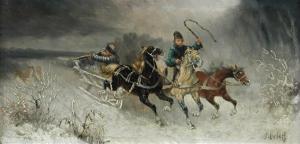
The two men, along with a handful of the curious, stood in front of the tavern.  Jekab harnessed his horses to the troika and climbed aboard, turned it toward the river, and gave the reins a firm and resounding slap.  Off they went.

It must have been quite a sight.  Steam rising from the horses’ nostrils, the troika’s runners cutting through the mighty snow bank onto the river, Jekab swathed in fur, urging his horses into the blinding storm at the top of his lungs.  Then – silence.  They all disappeared.  All of them: horses, troika and great, great grandfather.  None of them was seen again until the spring sun melted the ice against the bridge down river.

Gint had won his bet, but lost his friend.  Life is like that.

T. Orloff.  19th c. Russian

T. Orloff. 19th c. Russian

Exile’s Child

I’ve just moved my poetry blog, Exile’s Child , to WordPress.  Please have a look!