Publish, perish

“I really like your blog.  You should publish that stuff sometime.”

Ever hear that? It’s an interesting point, this question of what counts as publishing. Certainly, when you press the “Publish” button and send off your work to the ether, it is made public in a way that anyone can access. But is it publishing?

Put another way, would Walt Whitman, famous self-publisher, have been content to be a blogger?

Self publishing, except possibly for Walt, carries an onus to start with; that’s why vanity presses are called what they are. As if convincing a paying publisher somewhere of the value of your work removes vanity from the picture. Ultimately, WordPress, Blogspot, Tumblr, and even Facebook and Twitter are vanity presses, well within the usual meaning of the term. Walt would undoubtedly have been all over them.

So, what do people mean when they say you ought to publish your blogs? Two things, I think. First, there is a long standing distinction between publishing in a serial medium, such as a newspaper, magazine, or, yes, blog, and publishing a book. Dickens, Conan Doyle, Mitchener, all followed serial publication with book publication of essentially the same material. The distinction even allows, perhaps invites, revision. Serial publications are akin to drafts, in a sense.

The other thing people mean, however, goes to the heart of vanity vs. commercial publication: It’s not “real” unless you’ve convinced someone else that it’s worth an investment of time and money. The implication is that anything published commercially is better than anything self-published. A trip to any bookstore (if you can find one!) should disabuse you of that notion, but there it is. Commercial publication is still regarded as proof of value.

It’s not enough to have the heart of a poet; you need the soul of a salesman to really arrive. I wonder, though, how much of all this is changing, and how fast.

More heretical ideas

I could never understand the proselytizing impulse. After all, if one had the truth, wasn’t that the end of it? To be sure, there are some kind souls who would like to share heir good fortune, but that does nothing to explain the vitriolic view of infidels in general held by believers. Why this unreasonable insistence that people believe something, anything? Surely, if you believe yourself to have The Truth, all who failed to acknowledge that would be equal, whether they believed in a competing system or not. Finally, I think I have the answer. It came to me in a flash, like St. Paul. Lucky I wasn’t riding a horse.

If you’re pushing an agenda, you can’t count on anyone coming to your assistance on the basis of reason. Too unpredictable. You need blind faith for something like that. Similarly, it’s harder to predict the actions of another group if they’re being rational.

Reason is so fickle. Change one little fact and everything falls apart; worse, it’s impossible to know and take into account all possible factors. This is especially a problem when dealing with adversaries, who almost certainly have privy to facts which you do not. Ah, but true believers, that’s a whole different kettle of fish. You know straight up what they think, how they will react, and what their motivation will be. As for your own cohort, you can be sure of their support without lengthy and tedious rational explanation. All goes smoothly!

Now the only issue is to get rid of all those pesky infidels. You can’t count on them for anything.

Now there’s an idea…

I went to this restaurant in Riga.  Did I mention it was a family place?

Akumal 2010 015

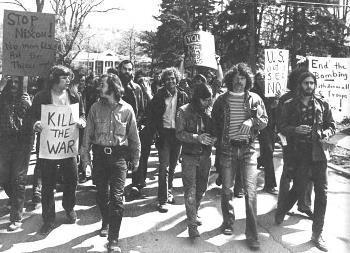
Draft dodging revisited

Let’s get one thing straight at the outset: Saving your own ass is a perfectly honorable reason to avoid military service, if you don’t see a compelling reason to go to war in the first place.

au-war-protest-w

And another thing:  those were crazy times, the 60s.

The beats, those semi-feral gnosticati whom we came to later venerate, were creatures of the WW II aftermath, in exactly the same way as the Lost Generation was of WW I.  An incomprehensibly brutal war had beaten the bejeezus out of the population at large, and those few sensitive and creative souls who could banded together in resistance to the Great Blanding that followed.  They were artists, primarily, painters, poets, musicians, above all uncynical and undisillusioned, still willing to bite on the bare hook, still enthralled by beauty and the ideal.  Do I surprise you?  That cynical, hip beatnik pose that’s so familiar was a disguise at most, at worst a caricature painted by a society that wanted nothing remotely experimental to happen for the foreseeable future.  The war and the depression it followed had been adventure enough, thanks.

But, for better or worse, the beats became famous, especially for naturally rebellious young folk, always feeling stifled, but particularly in that post-war treacle of the 1950s.  For them, Kerouac, Ginsburg, Ferlinghetti, and the rest represented not only freedom from accountability, but an expression of creativity completely unfettered by the constraints of the responsible, normal, world.  Never mind that Kerouac actually lived with (not to say on) his mother in Lowell between cross-country adventures, or that Ferlinghetti had served honorably in the Navy during the war.  Come to that, never mind that most of the people who so earnestly emulated them were safely enrolled in college.  It was a ramblin’ kinda thing by the early 1960s, a confusion of Woody Guthrie and William Burroughs, sort of a gay, jazzed up Alan Lomax thing, a place where Coltrane and Leadbelly were equally likely to be heard on the hi-fi in any given off-campus apartment.  And, thanks largely to sheer romance, it was all vaguely leftist.  Posters of Rosa Luxembourg, or someone equally suitably obscure, were everywhere.  People carried anarchist paperbacks in their hip pockets.  It never occurred to most to read the damn things.  Best of all, it was cozily small, an invitation-only subterranean elite.

I say this stuff as a member of that wannabe tribe, or, more accurately, as a wannabe member of it; my own background was far too odd for easy acceptance in what amounted to a splinter group of the middle class.  I was born a refugee, a natural intellectual, an ex-Catholic who grew up in a not-so-pretty working class neighborhood, in which the inhabitants would never have dreamed of calling themselves working class, or any other class for that matter.  In my neighborhood, graduation from reform school was as typical as graduation from high school, and of roughly equal status.  Almost nobody outside my immediate family went on to college.  Such was my enculturation; I didn’t have the savoir faire for acceptance as a middle class rebel.  Worse yet, as an exile from Latvia, I had no great affection for Marxist pipe dreams.  But enough disclosure.

In the midst of this happily angst-ridden fairyland, the war in Vietnam came gnawing like a small but determined troupe of mice in the pantry.  Begun by Eisenhower as a way to shore up Indochina after the expulsion of the French, it might have remained an obscure haven for covert operations, but for a series of circumstances, too complex to go into here, that led Lyndon Johnson to try to win it and get out quickly.  That meant escalation, and that meant that the draft, which during much of the late 1950s and early 1960s had been little more than a minor nuisance, became a jarring reality to the pleasant little community of rebellious savants, many of whom were in and out of college as if it were a game of musical chairs.  This was a real problem when it came to student draft deferments.  In those early days, if you lost your 2S status, you were next.  What to do?

Why, protest, of course.  At first, it was uncomfortably small groups carrying signs, in emulation of the Ban-the-Bomb rallies a decade earlier.  Intellectuals, who had studied the background to the war and had an understanding of the stakes, and of its place in leftist dogma.  Later, as more and more young men in college realized they could very well end up in the Army if nothing changed, the ranks were far less well informed, but considerably more sanguine.  I don’t impugn the integrity of each and every war protester of the era; there were certainly many who were sincere in their beliefs.  But many more simply wanted to avoid a dangerous detour in their well ordered lives, and still others saw a way to exploit a growing movement for their own ends.  Suffice it to say that the implications of the “Girls-say-yes-to-Boys-who-say-no” campaigns of the late 1960s were not lost on the many young men of the day.

Of course, people could have simply admitted that they saw no good reason for the war, and thus wanted to save their own asses.  After all, saving their asses was what the young men who did go to war were doing every day; nothing dishonorable about it.  Even those few who didn’t end up in Vietnam just by default of the system, and who really went on an idealistic mission to stop communism, in the end only fought to save their own asses, and those of their comrades.  Honesty, as usual, though the best policy, was the least popular.

As a result of all this duplicity, it became a Matter of Principle, which is to say that people chose up sides and bitterly denounced those who refused to join them.  It is a testament to this fundamental lack of good faith that to this day there remains a considerable amount of rancor in the remnants of the debate.

And me?  I got drafted, and ended up joining the Air Force, serving in Okinawa and Germany, ironically skirting Vietnam altogether.  I didn’t join because I believed in the war, or because I was afraid of the criminal consequences of dodging the draft.  I joined so as not to break my father’s heart.

That’s about all the honor I had in me; it still is.

_____________________________________________________

Photo credit: http://www.alfred.edu/pressreleases/viewrelease.cfm?ID=7252

How to build a fire

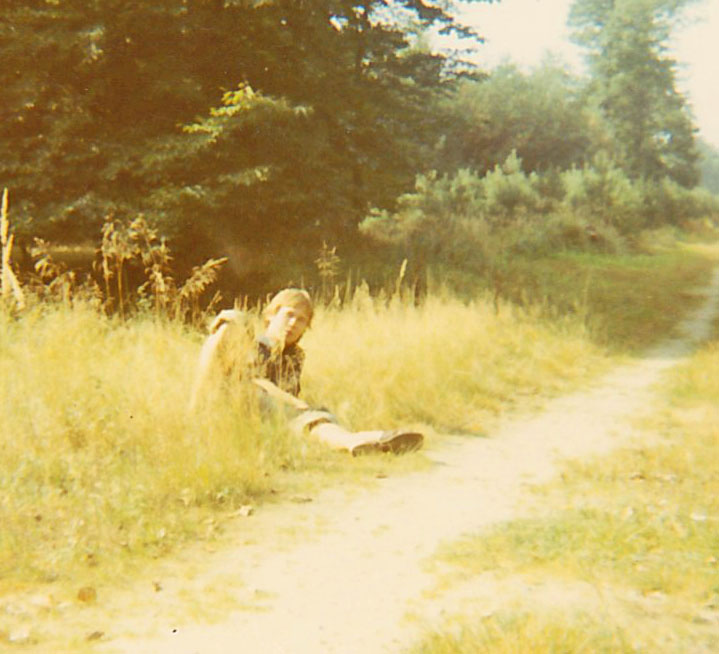
The woods around Frankfurt am Main, Germany, in the late 60s were scrupulously maintained by a cadre of forstmeisters.  Deadfall was cleared promptly, and cords of firewood kept at intervals along the well-groomed paths.  This was to be used elsewhere; open fires in these woods were strictly prohibited.  Germany, like all of Europe, was well trodden through centuries of settlement and resettlement, and Mother Nature was more a well kept mistress than a matriarch.

But this was, after all, the late 60s, and certain paths through certain quarters were undeclared free zones, and the minions of the psychedelic diaspora ran unfettered there.  In one such area, we maintained a kind of salon-in-the-wildwood, with a commandeered military shelter overlooking a campfire that was more or less permanently smoldering.  That fire saw faces and feet, new and familiar, come and go through many nights.  Tall tales, laughter, music, and in one case, an improvised artistic stick-throwing contest, filled those days and nights like the billowing cannabis smoke pouring from the tent.  It was, as I believe I’ve mentioned, the late 60s.

On one particular sodden day, after a solid week of rain, a friend, call him Chuck, and I arrived with the idea of cheering things up with a nice, cozy fire.  After a half hour of rummaging through the surrounding woods, we managed to collect a halfway decent pile of not-so-wet wood.  For kindling, there was always sufficient litter in the tent, partly collected for that purpose, partly the natural detritus of exuberantly youthful living.

So we began.  First, a crumpled piece of paper, with informally piled twigs atop, failed to catch.  Then Chuck suggested a teepee.

“What?”  I said, “You mean the tent?”   Chuck snorted and rolled his eyes.

“No, it’s a Boy Scout thing.  You stack small firewood in a kind of pyramid, then light it.”

“You were in the Boy Scouts?”

The teepee, too, smoldered hopelessly, as another friend, Herbie, arrived, surveyed the situation, and declared the obvious solution.

“You need a log cabin.”  Great, I thought, we’re going to run through the entire history of architecture here.

Nevertheless, what we were doing wasn’t working, so we carefully laid small sticks, of a size precisely to Herbie’s specifications, and stuffed paper from the dwindling supply into the ground floor.  The lighting ceremony was accompanied by the lighting of a large joint Chuck had been preparing.  All went marvelously well.

Except for the part involving the campfire.  It produced lots of smoke, but not much else.  Herbie declared all was going according to plan, that the wood just needed to dry out a bit.  Chuck pointed out the fire had been planned for that day, and not the next.  Chuck and I laughed uproariously.  Herbie grunted and stuffed the last remaining kindling into the structure.  We watched as the fire blazed up, consumed the dry paper like it was … dry paper, then died back to a dull occasional flicker.

Jens arrived.  Jens was from Antwerp, and as far as any of us could figure, had been on the road since shortly after birth.

“What’s happening?” he said.  From anyone else, this was a standard hippie greeting, the equivalent of a grunt of acknowledgment.  From Jens, it was a reasonable question.

“Trying to build a fire,” I offered, “but it’s just too wet.”  Gloom.

Jens looked at the pathetic little pile of semi-charred sticks, and, without a word, turned and walked away.  Just not willing to sit in the damp woods without a fire, I thought.

We continued our discussion of what to do next, whether the attempt was even worth continuing, when he returned.  He was dragging a sodden-looking, moss-covered log, about a foot in diameter and roughly five feet long, which he promptly dropped squarely on top of the remains of our fire building exercise.  A few halfhearted sparks flew out in protest.  A collective groan arose to compete with them.

“Jesus, Jens, thanks a hell of a lot!”  Herbie said.  He had still not used up the last of his theories in defense of the log cabin method.  Jens shrugged and sat down to join us.

We moped in silence for a good ten minutes, until the first flames began licking up the sides of the log.  In a few more minutes, the fire was roaring away; I was dumbfounded.  I looked at Jens with incredulity.

“What?”  he said.

IMG

“Jens,” not his real name