At last, a perfectly secure method of communication!
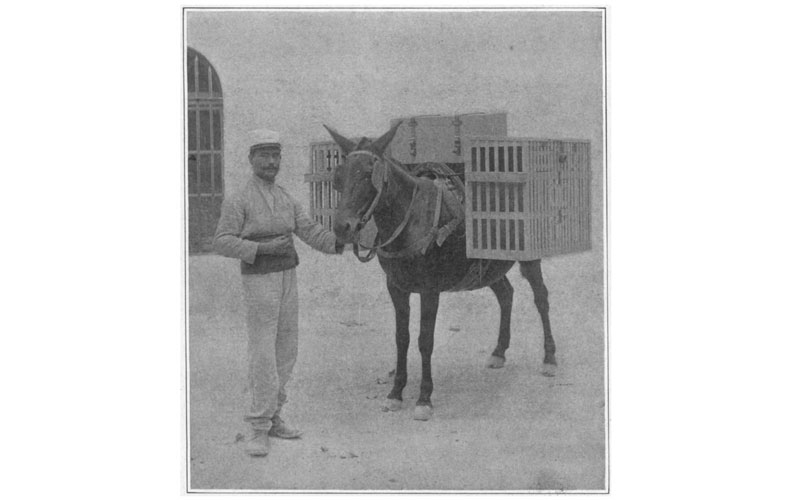
Carrier pigeons, used as secure communication during WWI. (Credit: http://bit.ly/145XegM)

At last, a perfectly secure method of communication!
Carrier pigeons, used as secure communication during WWI. (Credit: http://bit.ly/145XegM)
Riga is music; any season, but in summer, everything and everyone moves outdoors. The winters are long, dark, and cold, and Latvians figure to get the sun and fresh air while it’s available; plenty of time to rest after the leaves start to fall. Everywhere you look, people are picnicking in the parks, or boating on the canal, or just sitting at cafes. Nobody sleeps, really. Many are the deep, peaceful slumbers, when it finally gets dark, interrupted by a full-throated early morning choir of well-lubricated revelers, their songs echoing back and forth between the buildings, much as they themselves might bounce between the same walls. Latvians love their beer, and it is excellent; this fact in turn invites like-minded tourists to join in. The saving grace is that the most violence you’re likely to see is perpetrated against the principles of harmony, and not people. My view is that if I must put up with drunks, I much prefer them prone to outbursts of song than to outbursts of violence!
There is a plethora of music in official venues: concert halls, arenas, amphitheaters, and bars. But to me, what really defines Riga in the summertime is the street music. It is actively encouraged; the many local music schools even send their students out on the streets to perform, as a way of getting experience. And, of course, there is the usual variety of street buskers, although it’s not everywhere that they set up complete with generators and amplified instruments. The sheer range of talent and production value on the street is astonishing.
I wish I could have sampled the sounds for you, but I’m afraid it’s beyond my small competence to putt something like that together. So here’s a photographic journey instead.
Enjoy!

This trio was playing a Boccherini quartet. If they had another person, I guess they could have gone for a quintet. They were fantastic.

There was even the occasional official paid gig, like this one at an upscale hotel. Outdoors, of course.

Big production number here; very professional, great vocalist. They had a gas generator with a long enough extension cord so that it didn’t interfere too much.
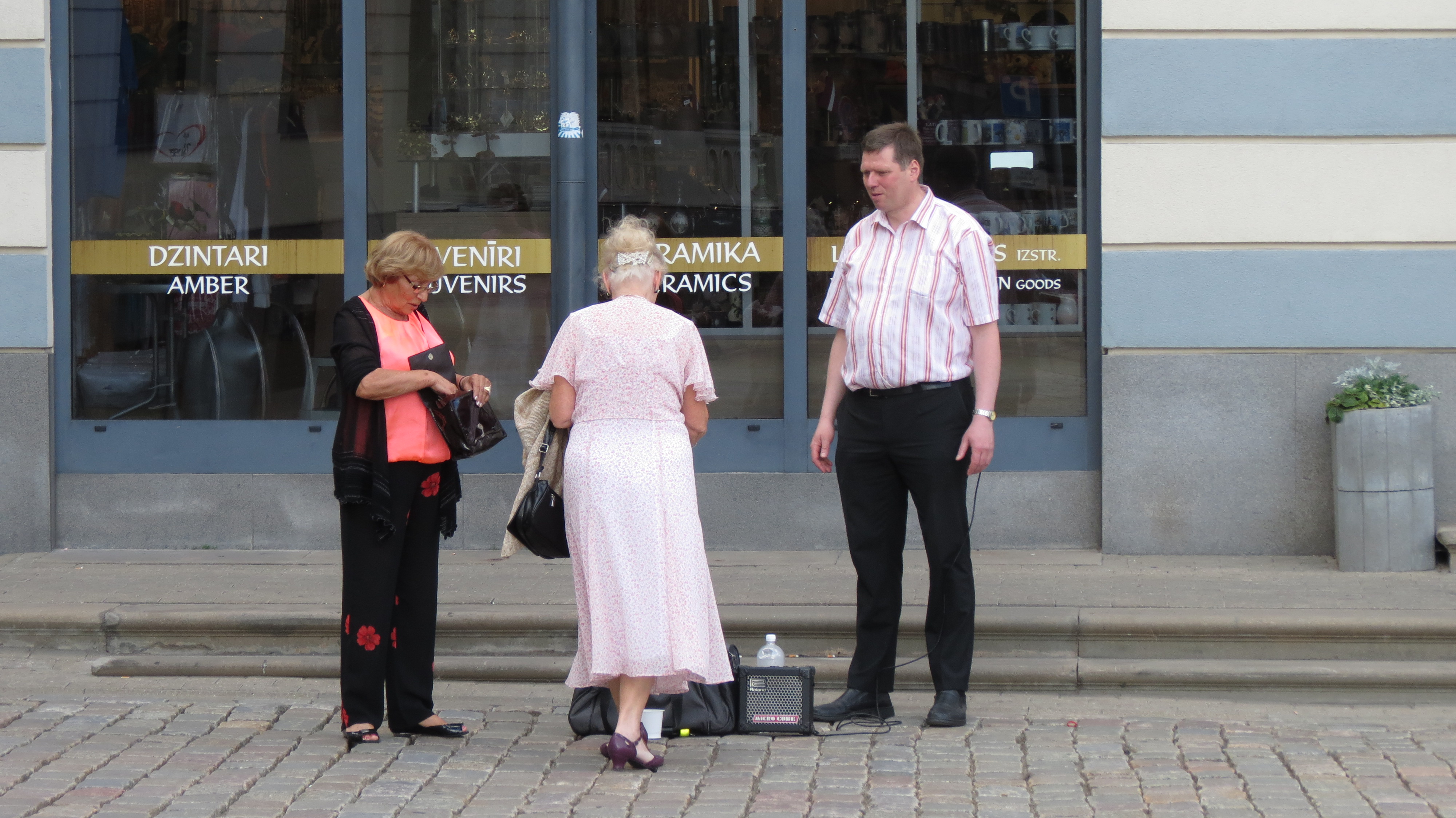
Then there was this guy, a marvelous operatic baritone.

Cello chiller.

I actually thought I might know this blues harp player from my checkered past. Then I realized I’m old enough to be his father.
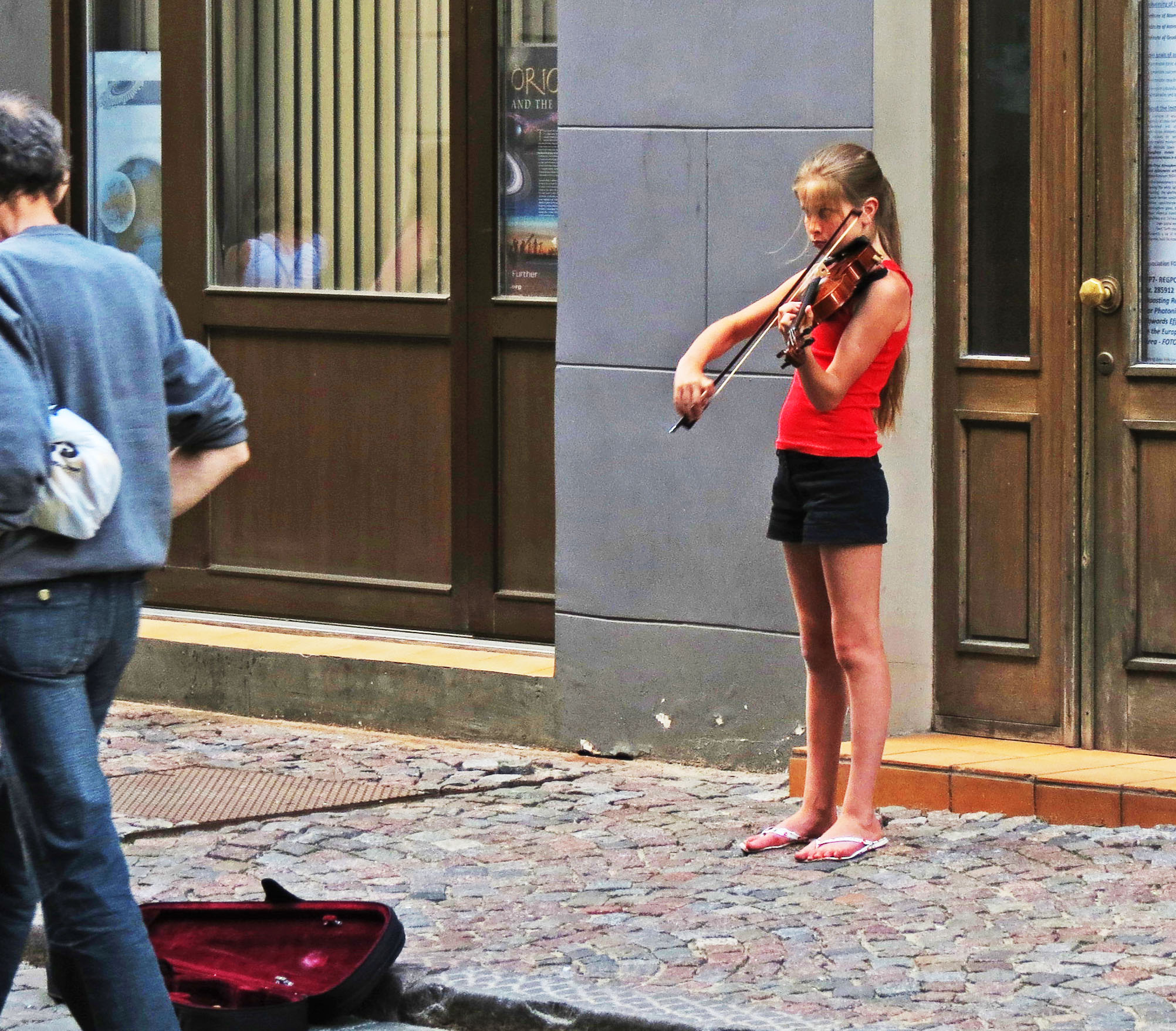
They start young. Good posture, sweet sound.

A one-woman band, and with an attitude. Her schtick was to ask passers-by to sing a verse of their national anthem. Then she would make it sound like everything else she played.

Ragtime Cowboy Joe.

Not a cowboy. Some people apparently just needed the money. The quality of this group was variable, but you had to give them credit for doing something, and not just begging.

Even Anonymous apparently was represented. An interesting cure for stage fright!

Very proper, and with a beautiful clear voice. She played a traditional instrument and sang Latvian folk songs, even dressed the part.

Of course, it’s always nice if you have a buddy to help with the music.

Uh, no comment.

More solid traditional music, despite the cowboy hats.

Some interesting combinations…

Lots of brass bands. These guys were excellent; no need for amps here!

Or here, for Mr.Cool.

Another brass band.
That’s all, folks!
The good news is, I’ve figured out writer’s block.
For the last few weeks, I’ve been unable to look a blank page in the eye. Worse, not even the frequent notes to myself, made in feverish wakeful nights, have elicited more than a yawn. Lost sleep for nothing, dear friends.
In the morning, I read my scrawls, trying vainly to recall what “Res. wh. whump!” could possibly mean. Or why the revelation that people have two of everything but probisci might be of interest to the bloggerati. Having failed, I hereby donate both ideas to the writing public; I would love to read something they inspired.
I tried all the usual antidotes, including the oft-prescribed stream of consciousness ramblings. Sure enough, they proved to be ramblings. Consciousness, I’m not so sure. My streams seemed clogged; too often for comfort, in a terrifyingly relentless dwindle, I found myself repeating one or two words over and over. Drowning in a sea of – well, not even drowning, not even that, which would at least have been tragic.
One wearisome evening, I gave up early and shut my computer down.
“Installing important updates,” it said, “Please do not log off or power down your computer.”
Brilliant, I thought, can’t even give up properly. Then it hit me.
My brain had been sluggish lately, reluctant to follow my commands. Just like my computer. I needed to install important updates.
Forget writing, forget blockage. Start the shut-down process. But how to download the necessary updates?
Jump in the car, take a drive. Read billboards. Stop for coffee. Buy some paint at Lowe’s. Or just look at paint, and decide not to. Talk to a human, any human, preferably one you wouldn’t normally find interesting. Go to a public park. Go to a museum and look at art. Get out among people, the more, the better.
Do this for a while; it can take days to download these updates. Just don’t think about writing. Eventually, just as you’re heading out the door to go grocery shopping, you’ll realize you need to write something down first. It will end up taking much longer than you thought, and you’ll have to eat out, since you will have forgotten all about the groceries.
Update successfully installed.
The bad news, of course, is that none of this is any different from what you’ve been doing all along.

“Ainava,” Konrads Ubans
The term of President Mohamed Mursi ended abruptly Wednesday, as the Egyptian army took control, arrested him, and declared his government over. A coup, in plain words, toppling the country’s first democratically elected president from power. We should be outraged.
Or should we? Mursi’s missteps, succinctly recounted in this Reuters article, seemed to almost ensure his demise, but incompetence, even recalcitrance, alone doesn’t justify annulling a popular election. What doomed his regime, and what, to me, provided reasonable cause for his removal, was his November 22 hijacking of the constitutional assembly process. On that day, he assumed for himself emergency powers, by which any and all oversight of the assembly, previously packed with his Muslim Brotherhood compatriots, was crushed. This included any discussion of the packing itself.
When the assembly predictably returned a constitution leaning heavily toward Islamist principles, the public rebelled, and took to the streets once again. Mursi’s response: quell the demonstrations, force an early referendum, before the opposition had a chance to organize itself, and ram the new constitution through. Every move after that was right and proper, according to the new constitution, but if the constitution itself is suspect, such legality is moot.
Mursi’s victory was on the slimmest of margins, and was largely the result of the disunity of the opposition. As it was, he was forced into a runoff against Ahmed Shafik, who was arguably handicapped by having been Prime Minister under Hosni Mubarek. Shafik still managed 48.3% of the vote.
This is the crux: having won by a small margin, Mursi proceeded to rule as if he had a crushing mandate, assuming emergency powers when conventional channels disfavored him, and thoroughly ignoring any of the concerns of the opposition, accusing them instead of subversion. No compromise.
So, the burning question is, is democracy simple majoritarianism? We hear a lot about majority rule with regard to democracy, but is that all there is to it? In the United States, the constitution, specifically the Bill of Rights, declares otherwise. The very concept of rights quite bluntly limits the power of the majority to enforce its will, and protects minorities from its ill will, right down to the individual. I use the term “minority” here in its strict sense, not the political sense of identifiable interest group.
But on a subtler level, the implication is that the interests of such minorities must be taken into consideration by the leaders elected by the majority, even when swept into office by groundswell. Still more, when the margin of majority is as thin as spring ice.
Which brings us to the infamous gridlock of American politics. It is grounded on the idea that, in a democracy, the winner takes all, that it is unnecessary, even irresponsible, to compromise with the losers.
We seem to have a lot of Mursis in American politics these days. Let’s take Egypt’s fate as an object lesson, and avoid that treacherous path.
We live in fascinating times. We are outraged by government incursions into our corner of the Grand Database, while at the same time we cheerfully surrender any and all information about ourselves for a 10% discount at Best Buy. In fact, we seem to be outraged by almost anything the government does these days, up to and including holding public trials to determine someone’s guilt or innocence, which we now seem to be convinced are contrived and predetermined whenever they fail to conform to our own conclusions. These conclusions, of course, are based on what information we could glean from the news media, which we firmly believe are utterly untrustworthy, with notable exceptions, which I’ll discuss momentarily..
How has it come about that we offer up the most bizarrely intimate details of our lives daily on Facebook, yet man the barricades when it transpires that some government agency might have been reading them? Or cough up our phone numbers and email addresses on demand when checking out at Home Depot for no apparent reason?
Well of course, you say, no point in getting a loyalty card, and then clamming up about it, is there? There’s a sacred bond involved, similar to the bond that ties us to certain news outlets, those we are sworn to believe regardless of the absurdity of their dispatches. Therein lies a glimmer of hope for resolving this crisis of confidence.
Government loyalty cards. Get a loyalty card, and get a discount when you present it at tax time. Pay more taxes, get a bigger discount. We’d even get special offers in the mail, both snail and e, for holiday sales tax rebates, or jury duty aboard a luxury cruise ship, half price if you volunteer immediately. All of this can be easily paid for by adjusting the “normal” tax rates for those who don’t have loyalty cards.
We might believe everything the government tells us, as we do with Fox News or The Guardian, if we thought of them as our tribe. We might even believe government policies are based on the moral code of humanitarianism.
Beauty thrives in small spaces
Musings, Opinions, Imagination, Fiction
A Blog about magic, fiction and art
Not really embarrassed.
Is this real life?
Stories and Satarical Commentary For Earthlings & Other Aliens
Writing Lostness
Stories and Reflections Through the Social Lens: Essays on Identity, Culture, and Society.

 Omniop