A rear-view mirror is still a mirror

People say all the time that they have no regrets.  Me, I’m practically defined by them; a man with no regrets is a man with no imagination, as far as I’m concerned, and I say that all too often for people around me, I suspect.  Still, I confess I’m mystified by people who essentially admit they can’t think of anything in their past that could have gone better had they made a different decision.  Equally, I fail to understand the virtue of still being the same person you were 40 or 50 years ago.  As Muhammad Ali said, someone who has the same opinions at age 50 as they had at age 20 has wasted 30 years of life.

Maybe that’s why, now that I’m old, I have this strange compulsion to revisit my life, to retrace my steps.  I’m drawn to places, both actual and conceptual, I passed through on my way here, to physically visit them, to stand in my own footsteps to see — what?

It’s not at all clear what it is I’m looking for, certainly not a glimpse of myself as I was then; that’s a vision that’s all too clear.  Nor is it primarily an attempt to reconstruct what I was thinking, to re-find or redefine whatever it was I thought I was doing, although that would certainly be interesting.  I’m not looking for redemption, or even a rationale.

Part of it is to correct the unconscious revisions I have made to my own history.  I’m sure you’ve had the experience of reconnecting, after many years, with an old friend or acquaintance, only to find that there are at least two contradictory versions of some common experience.  These things are seldom resolved, though.  We generally each come away wondering how the other person could have gotten the memory so wrong and yet be so sure.  It needs a new term to describe these common events.  How about “memoroid?”  I think that has enough innuendo hanging from it to serve the purpose.

No doubt what I’m looking for is a lot closer to hand and a lot easier to get at than a precisely calibrated reconstruction of the past.  See, I don’t think you can have a realistic assessment of who you are without a clear picture of who you were.

That gets both more and less difficult as you get older.


A somewhat immodest proposal

We Homo sapiens have been around for at least 250 thousand years. The first hints of agriculture appear about 12 thousand years ago, or just under 5% of our existence in our current biological configuration. We’re still evolving, of course, but it’s a slow process, and it’s reasonable to think we’re not much different from those earliest farmers, who were essentially hunter-gatherers with a fancy new startup.

For the majority, then, of our existence, we made our living hunting and gathering, which limited the size and distribution of us. Conditions differed from place to place, of course, but, as a rather small total population, we weren’t in that many different places for a very long time, so those limitations tended to average out and produce groups of 50-200 or so individuals spread rather thinly on the surface. Too many people meant not enough to eat, so a sensible strategy was to avoid other people whenever possible; not all that hard in the beginning.

One way or another, though, we figured out that it was best for us to get marriage partners outside our own groups; how and why is a contentious issue among anthropologists.  In any case, it meant that groups needed to stay reasonably near each other.

It’s not hard to see the awkwardness caused by these two competing strategies. On the one hand, we were congenitally suspicious of outsiders and wanted to either drive them away or kill them, while on the other hand we needed them to procreate. What to do?

The answer was to limit our interactions with other groups in general via warfare or other hostile behaviors, while consolidating our relationships with one or two select groups via intermarriage. Brilliant!

In my opinion, the spread of farming once it was discovered was due to this dynamic of wanting to get away from other people while simultaneously seeking marriage partners among relative strangers. We see this time and again, even explicitly as excuses for expansion, from elbow room to lebensraum. It also explains the intermarriage of European nobility; it’s not that they found each other so irresistible. In a sense, it’s just scaled-up hunter-gatherer strategy.

Which brings us to my proposal. Donald Trump, are you listening? Your son, Barron, is, what, 10 or 11 now? Through most of history, that’s plenty. The great statesman and diplomat Dennis Rodman tells us that Kim Jong-un has a daughter named Ju-ae, who would be about 8 or 9.

I think you can guess where I’m going with this.

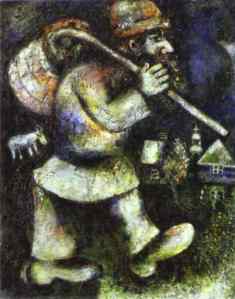
Le Juif Errant

Mikels Skele's avatarOmniop

For the end of a week in remembrance of the Holocaust, I am offering up this post of mine from a couple of years ago.

the-wandering-jew-1925 Le Juif Errant, Chagall, 1925

When I was a boy, I developed an aversion to the art of Marc Chagall.  Why?  Because some of his work was used to illustrate a catechism we were tortured with in St. Philip Neri School.  I had no way of knowing at the time that St. Philip himself, a notorious iconoclast, would probably have flung the damned book out the window if we found it distracting.  After all, when one of his monks came rushing to him all aglow with the news that the Virgin Mary had visited with him while he prayed, he advised him to spit in her face the next time she disturbed his meditation.  Had I known, I might still be among the faithful, but…

View original post 846 more words

Humbled

What does it mean when someone says they are humbled by an experience?  Taken literally, it would mean they are made to feel more humble, which is to say less proud.  And yet, I would venture to say that most of us have never heard anyone use the expression in a context in which that makes sense, inasmuch it is almost universally used  on the occasion of receiving  an award. Usually, the humbling is accompanied by an expression of pride and gratitude.  The higher the honor, apparently, the more humbling the experience and the greater the pride.

There is only one sense in which winning an award can be a truly humbling experience, and that is if it is undeserved.  Do you feel that your accomplishments are trivial compared to the work of other recipients?  Was the award completely unexpected because you think of yourself as just getting the job done in a workmanlike way, nothing special?  Do you feel that if the award committee looked back over your record they’d have to reconsider choosing to honor you?  Is the contribution of others unfairly minimized by their exclusion?

These are all perfectly normal reactions, whether valid or not.  They are also utterly inconsistent with pride, and the kind of gratitude that would be appropriate in this context smacks of favoritism and ulterior motivation.

If you truly feel humbled, the most honorable thing to do is to turn down the award and explain your reasons.  If, after mulling things over, you decide you deserve the award after all, accept it with grace and pride, never mind the false humility.  If you still feel the award is undeserved, but it would create awkwardness for the committee to turn it down, well, you’re in a fine pickle, aren’t you?

It’s ironic, to say the least, that when someone actually does turn down an award, they are almost always criticized for being too full of themselves.

In truth, I suspect that most of the time it is simply formulaic, the right thing to say in the same way that people say “pleased to meet you,” or “sorry for your loss.”

But I can’t help it.  It’s my duty as a curmudgeon to harp on these things.


Modern Living

The latest in my on-going, if informal, technology series. Or, put another way, some more whining about machines.

I have a machine that washes my clothes for me. It is a shiny new (ish) Samsung, the model which was flinging off lids awhile back, probably in frustration at having to deal with unpredictable biological organisms like us humans. As it turned out, my machine was not one of the ones with that problem, although it was the same model number. Those were specially manufactured for Sam’s Club, which had demanded a lower price. They got it.

So as not to leave ordinary, hard working machines like mine feeling ignored, Samsung sent a guy over to bolt some stuff together all the same. And (I suspect just to leave evidence he had been there) he also “installed” a new faceplate, by which I mean he pressed the pre-glued replacement on over the existing control labels. It’s a dandy, striking black and silver against the pure, Caucasian white of the machine, stunning. The only other change I could see was that the setting called Bedding had been consolidated with Delicate.  Keeps those blankets in a low-spin zone, so the machine doesn’t freak out and start stripping off its coverings.

It is a marvelous machine for sure, but it has a little quirk, not serious, but just enough to remind me who’s boss: it keeps time like a computer update status bar.

This shouldn’t be surprising, since it has been many moons since washing machines crossed the invisible line from mechanical gadgets with computers attached to computers with mechanical gadgets attached.  As such, they have their own reality.  For example, when I put in a load and close the lid and press Start, a little LED countdown timer appears with, say, 45 minutes showing.  Long experience has taught me that I need to set a timer upstairs as well, since it’s hard to hear the delicate little jingle Samsung plays to let me know it’s done.  It’s just as well; I swear it’s the same jingle the Mr. Softee truck used to play when I was a boy.  I get a strange craving for ice cream whenever I happen to be in the basement when the washing machine has finished its cycle.

Experience has also taught me that I need to set the upstairs timer to 50 minutes instead of 45, since it works on the same basis in reality as I do.  Usually, this does the trick.  The wash cycle usually lasts anywhere from 45 to 50 minutes.  All’s well that ends well.

Except that now and then it takes appreciably more time.  Or less, but that’s very rare.  It seems that it sometimes transpires that it isn’t quite satisfied with the level of cleanliness it has achieved  for my clothes, and runs them through an extra rinse cycle.  When it does this, all bets are off as to when it will actually get done.  My upstairs timer goes off, and I go down to change the laundry, and the washer is chugging merrily away.  Almost smugly sometimes, I swear.  I look at the LED.  It says 15.  Or 8, or some other such number.  Ok, fine, I think, be that way.  I go back upstairs set the time to the new time, and wait.  Now and then, if I’m close enough to the basement door, I hear the little jingle a couple of minutes early, as if to say “Ha ha, just kidding!”  More often, I go down at the appointed time, and there’s still a minute or two left.  I use that time productively.  I stand there and stare at the washer until it stops.

When it finally gets tired of the game and stops, I transfer the clothes to the (somewhat) matching dryer and the little dance starts all over.

Well, ok, you might call this a first-world problem, especially if you’re given to especially trite catch phrases, but it’s symptomatic of what I call Global Robo-Creep.  Everywhere you go in the world except the most destitute reaches of the outermost hinterlands of civilization, more and more computers are doing what used to require humans.  Even simpler machines like parking meters have no job security anymore, replaced by touchscreens and credit card slots featuring arcane instructions designed to use up your allotted parking time before you even get properly started.  And cellphones?  Don’t ask!  Even the !Kung-san of the Kalahari have better 4G availability than you do.  Yes, this is all making life more … interesting, some might say better.  Certainly, in the case of washers and dryers, life is made both easier and more convenient.  But here’s the rub: it’s all done on the machines’ terms.

Yes, yes, of course, I know it’s a cabal of coders who actually animate the machines, and they’re undeniably human, but so was Faust.

How would you like to be on a help line with Faust?  Who do you think would come out ahead?  Hint: it’s not human.