Rude awakening?

The Egyptian army cracks down on the Muslim Brotherhood; the majority of the population approves.  Greece arrests members of the fascist Golden Dawn party, including members of parliament; their popularity crumbles.  Not much to go on, if you’re looking for a trend, but it’s enough to ask the question, are we getting tired of extremism?

Up til now, to be extreme has been the height of fashion.  Even the dullest events and pastimes have jumped on the extreme bandwagon.  Extreme knitting would not have raised an eyebrow.  No limits, all out, leave it on the field.

It’s my suspicion that all this tolerance, and even preference, for extremism is a by-product of the unprecedented prosperity of the two decades prior to the 2008 meltdown.  When things are going well, why impose limits?  Wasn’t “no limits” the mantra of the feel-good 90s?  It was fully entrenched by the time people were engulfed in recession; it must have seemed the right approach to bring the crisis to a close.  There was a lingering suspicion that the problems were caused by timidity, in any case, and all that was required was more bullishness.  It’s a commonplace that the first reaction to an ideological crisis is retrenchment.  We’re having problems?  We haven’t been true enough to our principles.  The Peasants are rebelling, reaffirm the authority of the aristocracy.  Religious fanatics commit mass murder, hurry off to church.  We see it time and again down through history.

Seen in this light, our devotion to the extreme looks less like a devil-may-care embrace of uncertainty, and more like a conservative retrenchment.

But in all such cases, there comes the creeping realization that not only are things not improving under this program, they are actually getting worse.  Retrenchment collapses under its own burdensome weight.

If what we are seeing abroad is the first faint glimmering of this collapse, we can only hope it reaches our shores before the lunatics destroy our government beyond redemption
Killers

John Coyote has written a raw and powerful poem, Killer on the Road, about being a soldier.  The style is terse, the language rough.  The odd grammatical lapses, whether from art or habit, lend the poem a particular ragged urgency, like the sharp edge of a rusty piece of scrap metal.  This comes just in time for the latest debate, about whether or not to bomb something, anything, in Syria.

We suffer no shortage of moral pronouncements from either side, each more strident than the last; Coyote gives us something more precious, and far more useful: a portrait of a human being caught in the crosshairs.  In fact, it’s two human beings, caught in each other’s crosshairs, colliding, willy-nilly, in a reality of neither’s choosing.  For once in our most recent polemics, we see the enemy,  a suicide bomber, in his full humanity:

They killed his brothers.
They came to his country and torn it down to rubble.

He believed in a eye for a eye.
He will be in paradise soon.
Tears fall from his eyes as he think of his wife sleeping alone.

Suddenly, the suicide bomber is no longer a symbol, a cause, but an ordinary man, steeling himself to do what he believes he has to do, however delusional that may be.  Coyote makes no excuses here, pushes no particular agenda.  He simply points us to a reality we routinely choose to ignore: beneath the bomb filled jacket beats the heart of Homo Sapiens, one of us.  It doesn’t mean he’s justified in his actions.  It’s a mirror, pure and simple.  This is not a particularly new insight; battlefield correspondence from soldiers down through the ages reveals the same.  What’s new here and now is the permission to see it while we are still engaged in the conflict.  The soldier who, reacting instinctively to a threat, kills this man, ends up looking into this mirror, too long, perhaps, for his own good:

He hold pictures of a man’s wife  with two children.
He wonder why he has to kill this man?

He should of been home tossing a football with his brother or something.

He cries for the Iraqi he killed.
Old Sargent said he was a hero.

At this point, it’s too late for redemption:

He would do his duty and go home.
He don’t talk of God or Jesus anymore.
He just wishes for the blood to leave his hands.

There is no happy ending here, no satisfying resolution.  Scales drop from the eyes, but a lot that’s good in human values drops with them.

It’s a picture we need to hold onto while we’re making decisions that can kill not just bodies, but human spirits as well.  Coyote is clear about where he stands: stay home, no more killing.  Others might come to a different conclusion; there is the matter of precedent concerning chemical warfare to consider.  Either way.  Just let’s go into it with eyes wide open.

A little perspective, please

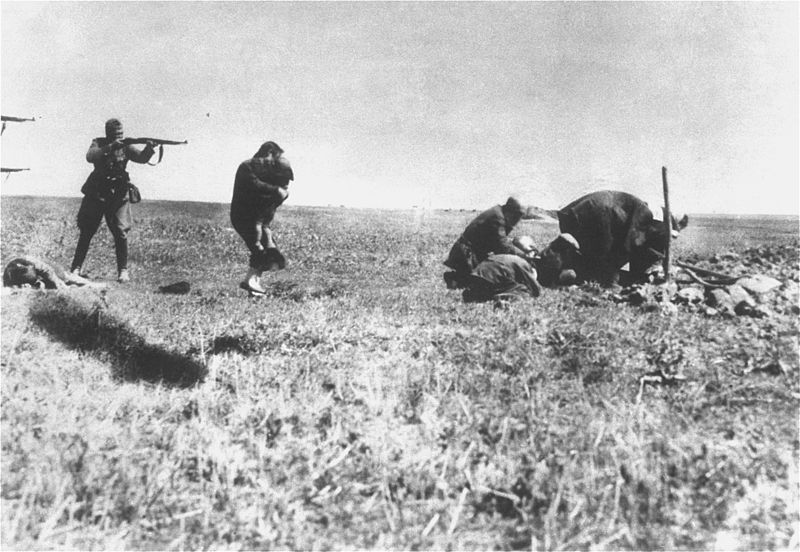
Jews being executed at Ivangorod.  Source: Wilkimedia commons

Jews being executed at Ivangorod. Source: Wilkimedia commons

I see a lot of gloom in the public literature lately, the idea that we have come upon horrible and chaotic times, the like of which have not been seen in recent history.  Certainly, some concern, even alarm, is justified, especially where global climate change is concerned, and I wouldn’t hesitate to acknowledge the seriousness of various international crises, especially those in the Middle East, but let’s step back a bit and take a deep breath.  How is humanity really doing these days?

Look, I’m no Pollyanna.  We’re not in Utopia, folks, I understand that.  And I fully understand the literary bias towards the dismal.  Doom looks more serious than optimism, pessimism is often mistaken for clear-eyed realism, and both are so attractive to writers facing a blank page that it’s no wonder how often they succumb.  I even approve of the role of writers as coalmine canaries, carriers of unpleasant but necessary information for the welfare of the society.  What I do object to is the increasing surrender to despair and bitterness (ahem, poets).  This abjectness is understandable for the victims of the various disasters occurring around the world.  It is inexcusable from people who, consciously or unconsciously, present their work as a sober reflections on reality.

Compared to the 20th century, the 21st, so far, is a cakewalk.  Are there wars springing up everywhere?  Not anything like World War I, in which 18 million lives were lost.  Soak that up.  18 Million.  But that was a drop in the bucket compared to World War II.  Estimates of fatalities in that war range from 60-85 million, about two thirds of which were civilians.  In addition to the roughly 6 million Jews that were fried in Nazi ovens, at least that many non-Jews were also executed: Roma, homosexuals, socialists, Catholic clergy, even persons whose great crime was that they were handicapped.  Not just in the line of fire.  All these people were systematically rounded up and executed, like so many floor sweepings.  Humans.  Mothers, fathers, brothers and sisters.  I often hear people sigh and wonder at the apparent inability of Africans and Arabs to live in peace.  They’re amateurs, compared to Europeans.

Let’s not forget the two major revolutions in the last century:  Russia and China.  In the Soviet Union, it is estimated that more than half of the 20-30 million casualties attributed to World War II can be tied to purges and forced mass migrations instigated by Stalin to rid himself of elements he considered disloyal.  The modern troubles in Chechnya and other hotspots in the Russian Federation can be traced directly to this.  Huge masses of native Chechens were moved out, and ethnic Russians moved in to replace them.  The gulags were full to bursting, in unspeakable conditions:  sawed-off oil drums as indoor latrines, little or no heating.  Often, inmates would waken in the Siberian morning with their hair frozen to the wooden pallets they slept on.

Let’s not forget diseases.  Horrible as the AIDS virus is, it’s not anywhere near as deadly as the 1918 flu epidemic, which infected about 500 million people worldwide, and killed as many as 100 million of them, almost 5% of the world population.  This came on the heels of World War I, whose charms I discussed above.

I could go on.  China’s revolution held its own horrors, including the Red Guard madness of the 1960s.  I won’t even start on the psychological damage attributable to the Cold War, and its policies of Mutual Assured Destruction, an apt acronym if ever there was one.

So why all the doom and gloom now?  Maybe it’s the instant and constant access to the global if-it-bleeds-it-leads news media.  Maybe, in the case of the US, where we seem convinced that not only is the world coming apart at the seams, but all our politicians are either evil, crazy, or both, we’ve grown so used to comfort that our greatest fear is losing some, even any, of it.

Wednesday quiz

Good morning boys and girls.  Today we have a short surprise quiz. In boca al lupo!

1. If you discover that the marjoram you’ve planted has invaded the rest of the garden, the correct response is to
a) Run about wildly cursing
b) Start a campaign to denounce marjoram as the great Satan
c) Throw up your hands in despair.
d) Cut it back and move on to something else.

2. In the above example, marjoram can be likened to
a) The government intelligence agencies
b) Corporate greed
c) Annoying personal acquaintances
d) All of the above

Democracy

Participating in democracy is not just shouting your particular dogma more loudly.  It’s having the courage to face that dogma, and test it, to research and confront your most ingrained ideas.  This requires hard work, I’m afraid, and may cost you some fair weather friends.  If this doesn’t appeal to you, I’m sorry.  Maybe democracy is not what you want.