A letter to the Director

To Mr. Benjamin Flitworthy, Director

Dear Mr. Flitworthy

I find your proposal to be ludicrous to the point of madness.  It causes me, indeed, to question your sincerity in pursuing this transaction.  To my knowledge, it has never been observed, nor yet postulated, that, as you suggested, pigs might fly.

Yours, Sir Nigel Blagh

The nature of nature

You’re a nature lover; you find it revitalizes you, sweeps away the cobwebs (never mind the natural nature of cobwebs).  Alright, then!  Where to find it?

Perhaps you like to leave the city behind, get out where the air seems fresh.  Climb the mountain that refused Mohammad, go on a surfin’ safari, that sort of thing.  The thing is, all this artificiality gets you down, bro.  I mean like, wires, concrete, dump trucks, horns .. it just makes your head hurt.  Well, okay, not literally, most of the time, but it’s bad for the soul, right?  It’s not right, right?  It’s .. we’ve screwed it all up, the ecosystem, and we need to get back to..

To what?  The Ecosystem, the grand, immutable, capitalized Ecosystem?  Which one was that?  A hundred years ago?  Two seconds ago?  It’s a dynamic system, meaning there is no ecosystem to get back to, because we’re in it.  Now.  Maybe you don’t like it right now; that’s another issue.

The whole distinction between nature and artifice is wrong.  A Massey-Ferguson combine is no less natural than the stripped-down twig used by a bonobo to get at termites.  The mound built by the termites is the same, in essence, as the Sears Tower.  The differences we see are matters of degree, not kind.

Does that mean I don’t believe there’s an environmental crisis?  Not at all.  But it’s not Mother Nature that’s in danger.  It’s humanity, one of her least understood offspring.  The Earth doesn’t need saving; it will be just as fine as barren, acid-scarred rock as it is covered with what amounts to a thin slime of life.  Does Venus complain?  Does Mars feel inferior?  Who really cares about the current state of a lump of matter in the great nowhere?

Well, we do, because we care about the existence, or not, of our kind.  We mourn the passing of creatures we’ve never seen precisely because we might be next; we show no such compassion  for those closer to us: mice, cockroaches, wasps.  But these, too, are our kind, our mushy, pushy, boisterous, gustatory kind: living beings.

I see the value of greenery and what we call wildlife.  We’re changing our circumstances much faster than we evolve.  That’s our nature, after all.  It’s just that we don’t have much of a chance at surviving it all if we insist on seeing ourselves as apart from it all.

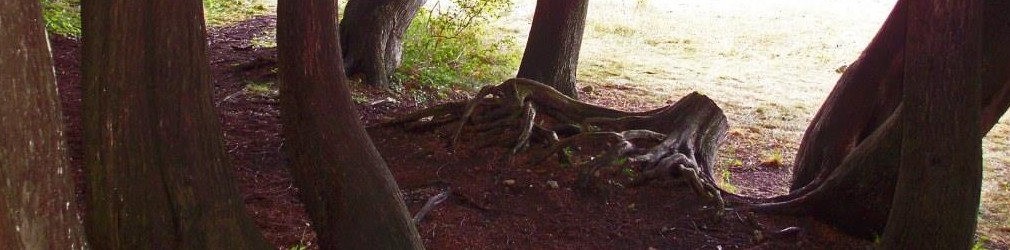
You want nature?  Look around you.  Cars.  Trees. Mountains.  Molehills.  Look inside that fortress skull in which you think you live.  That mushy gray stuff is as natural as sunsets and gamma radiation.
A report on alien life

At first we thought those were their bodies, with hard sleek exoskeletons of various sizes.  The shapes were roughly the same, although variations were plentiful.  The larger ones, which we assumed to be adults, were two to three times the length of the smaller ones, with much greater volume.  As we began to gather more information, however, we realized the ratios were not quite right, and there were too few intermediate forms for this to be a juvenile/adult distinction.  And yet, there were intermediate forms, so we were forced to rule out a larval stage.  Quite puzzling.

A few days into our study, one of us noticed one that seemed to have split in half; furthermore its exoskeleton was entirely missing.  Was this a beginning stage in reproduction?  We were very exited about the prospect of seeing such an event so early in the project, not to mention the opportunity to study the infra-skeletal structure.  I was fortunate to be assigned to head up the investigation of this new phenomenon. while the rest of the team continued as before.  On the first day of intensive investigations there was a most interesting occurrence;  one of the half-entities came further apart.

Needless to say, I was beside myself.  Nothing like this had ever happened in the history of these explorations.  Furthermore, it appeared that the quarter-entities that resulted  had quite differing characteristics: one retained its rigid form, but the other was revealed to be soft and worm-like under enhanced magnification.  Further, as magnification was increased, more and more of the worm entities became apparent, and were even seen associated with the larger, singular exoskeletons.

As you can imagine. the next few weeks were a turmoil of activity, as discovery followed discovery.  Complete data are coming under separate cover, but here is a summary of the astonishing conclusions to which we came.

1.  The “exoskeletons” are not skeletal at all, but are shells.  We came to this conclusion because they appear not to move unless associated with a worm entity.

2.  It is the worm-like forms that are the real entities, displaying volition and spontaneous motion, although very little outside their shells.

3.  The shells are nevertheless useless as protection, as they crumple easily, and exude a reddish liquid that appears deadly for the worms.

We hope to generate a more thorough report within a year upon returning home, which should be soon.  We will be leaving Earth orbit as soon as practical.